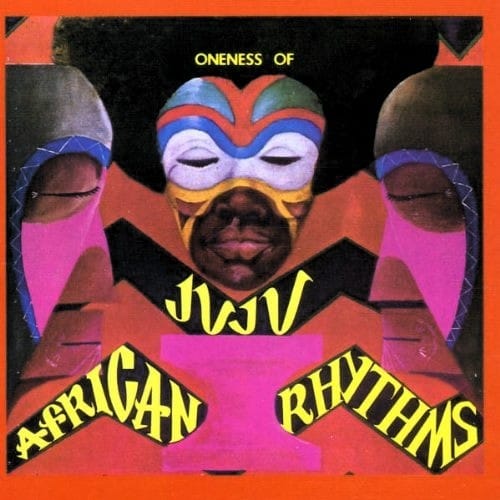
A spiritual jazz masterpiece from the Strata-East stable, *African Rhythms* marries African percussion with black American consciousness. It grooves hard, chants deep, and sounds like a congregation finding its voice. Essential for anyone who thinks jazz can't dance.
There’s a moment on African Rhythms where the percussion drops out and the chant begins—it’s the sound of a congregation that hasn’t been built yet. The voices rise in unison, a single note held through the heat of the room, and for those few seconds you’re no longer in 1975 Richmond, Virginia. You’re somewhere older, somewhere that doesn’t appear on maps.
This is the second album from Oneness of Juju, a group assembled by reedman and composer James “Plunky” Branch. By day, Plunky was a doctoral candidate in psychology at Howard University. By night, he was building a commune around the sound of African drums and American free jazz. The band was named after a Yoruba concept—the singular, interconnected life force that runs through all things. They meant it.
Recorded at Hollywood Sound Recorders in Los Angeles in 1974, the album was produced by Plunky and engineered by a young Baker Bigsby, who had cut his teeth on soul sessions for CBS. The tape machines were old Ampex two-tracks, and you can hear it—the drums have a round, punchy warmth that digital never quite recaptures. The percussion section alone was a small army: M’Bawa on talking drums and congas, Alafia on bata and agogo bells, and a rotating cast of hand drummers who sat in the live room without headphones, playing off the air.
The Groove as Prayer
Side A opens with “African Rhythms,” a track that builds from a single kalimba figure into a twelve-minute ritual. The bass line—played by James “Guma” Thompson—is a repeating three-note figure that never wavers. It’s not a solo. It’s a foundation. Over it, Plunky’s soprano saxophone weaves long, vocal lines that sound like they’re trying to speak a language not yet invented.
“Facts You Know” is the closest thing to a single, with its clavinet vamp and a vocal hook that could have been a hit if radio had been ready for it. Alafia’s chanting here is in the pocket of the drummers, not the other way around. That’s the secret of this album: rhythm isn’t the backdrop. It is the song.
The B side opens with “Kwaanza,” a seven-minute piece named for the harvest festival that had only been celebrated for nine years when this record was cut. Maulana Karenga’s creation was still new, still controversial in some circles. Oneness of Juju treats it as a call to gather. The track ends with a spoken-word passage from Plunky, reciting the seven principles over a fast-dying cymbal wash. It feels less like a statement and more like a benediction.
The Room You Can Hear
What makes African Rhythms endure is its refusal to polish the sweat. The congas are tuned high, the bass amp hums at the bottom of every quiet passage, and the vocals were recorded with a single Neumann U87 in the center of the room. You can hear the scrape of a chair. You can hear someone say “yeah” under their breath at the start of “Juju.” These are not mistakes. They are evidence.
The album was released on Strata-East, the label co-founded by pianist Stanley Cowell and trumpeter Charles Tolliver. It was the most vital black-owned jazz label of the era, and it treated music as a communal act rather than a commodity. African Rhythms fits that mission perfectly. It was pressed in a run of perhaps 3,000 copies, sold mostly at African cultural festivals and through mail-order ads in Muhammad Speaks. The fact that it’s still in print fifty years later is a small miracle and a correction.
Plunky’s later work would move toward funk and commercial R&B, but this record holds a different temperature. It’s the sound of a band that believed the rhythm could heal. Sit with it on a good system—let the bass drum thump against your chest—and you might find yourself believing it too.