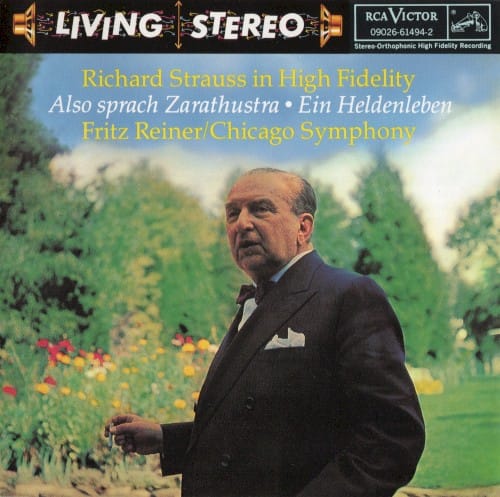
Fritz Reiner and the Chicago Symphony Orchestra’s 1954 recording of Richard Strauss’s Also sprach Zarathustra is the definitive version—a performance of such taut, transparent power that it redefined what orchestral recording could sound like. Essential listening for anyone who thinks they know this piece from 2001: A Space Odyssey.
The opening is the least of it. Yes, that sunrise—the low C on the contrabassoon, the horns rising through the darkness, the organ that finally rumbles in like God clearing His throat. But listen to what happens thirty seconds after the famous trumpet call. The orchestra collapses into a single, shimmering note, and suddenly you’re not watching dawn on a Kubrick set. You’re inside a concert hall in Chicago in 1954, and Fritz Reiner is conducting the Chicago Symphony Orchestra as if he had a secret line to the composer’s skull.
This record is why audiophiles still chase Living Stereo pressings.
Reiner and RCA Victor had been making history together since 1946, but it was the shift to three-track tape in 1953 that changed everything. Engineer Lewis Layton set up his microphones in Orchestra Hall—three Neumann M49s across the front, a pair of omnis for ambience, no spot mics on the soloists—and captured a sound so immediate that later engineers would call it a “window” rather than a recording. The stereo spread is almost hallucinatory. The strings are left, the brass is right, the winds settle in the middle, and the hall’s famous acoustic breathes around them. At certain moments—the big B-flat section in “Von den Freuden und Leidenschaften”—you can hear the bow hairs scrape across the cellos.
Reiner’s reading is notoriously controlled. He took the score at Strauss’s metronome markings, no rubato, no sentiment. The Adagio section “Von der Wissenschaft” unfolds with the patience of someone reading a physics paper. But that restraint makes the climaxes hit harder. When the “Tanzlied” breaks into its waltz, the woodwinds pirouette with a precision that sounds almost mathematical. And the organ entry in the finale—played on the mighty Kimball of Orchestra Hall, which had been rebuilt in 1952—has a weight that no digital remaster has ever fully captured.
The session musicians remembered Reiner as a lean, silent man who never raised his voice. He’d stop a passage, tap his baton, say one word—“Cello”—and they knew to listen for something off in the second stand. He was famous for his left hand. Other conductors used it to shape phrasing; Reiner used it like a scalpel, isolating a single player from across sixty-four musicians. You can hear that forensic detail in the strings. The violin solos, played by the legendary Milton Prinz, float out of the texture like they’re on a wire.
What makes this recording endure is not the interpretation. It’s the moment in history it captures. 1954 was the year stereo recording came of age. RCA had spent a fortune developing the technology, and Reiner, a notoriously demanding musician, insisted that every instrument sound as it would in a live hall. Layton’s three-track masters became the gold standard. Later engineers would remix them for CD, but the original mono and stereo releases have a coherence that no post-production can fake.
You don’t listen to this record to hear the piece. You listen to hear what a room full of master musicians and one obsessive conductor can do when they’re not trying to be impressive. They’re just trying to get the notes exactly right.
And then the sunrise happens and you forget all that.