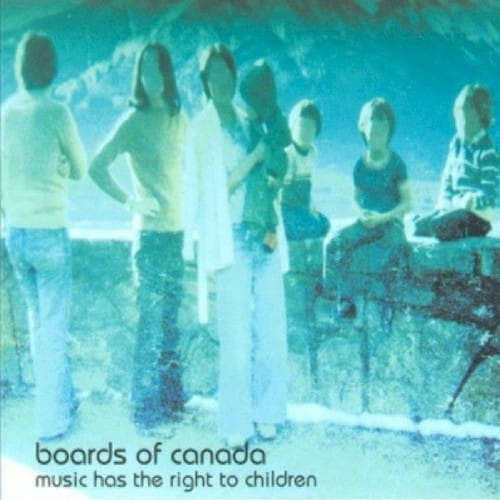
There are albums that sound like memories, and then there is the one that sounds like the memory of a memory. Boards of Canada’s Music Has the Right to Children arrived in 1998 already dusty, already faded, as if it had been pulled from a time capsule buried before you were born. The cover alone—that blurry, snow-flecked photograph of a child’s hands cradling a glowing object—sets a tone of something retrieved from a lost moment.
The album is not really about the future. It is about the past, but a past that never quite existed.
Michael Sandison and Marcus Eoin, the Scottish brothers behind the project, built these tracks from analog synths, tape loops, and samples pulled from educational films and public television. The result is a kind of sonic nostalgia that feels more real than your own childhood. You hear the ghost of a classroom filmstrip, the hum of a school gymnasium, the distant laughter of children who might be you.
“Roygbiv” is the song that stops you cold. Six notes repeated on a slightly detuned synth, a beat that shuffles like a kid walking home from school, and beneath it all something that sounds like a memory you can’t quite place. It is simple, almost absurdly so, and yet it has never stopped sounding like a secret.
“Aquarius” builds from a spoken-word sample of a child’s voice counting and spelling, layered over a warm, wobbling bassline. The effect is disorienting. You are not sure if you are listening to music or remembering a dream.
What makes the album enduring is not its technical innovation—though the production is meticulous—but its emotional precision. Boards of Canada understood that the most powerful nostalgia is not for a specific time or place but for a feeling. The feeling of being young enough that the world still held codes you hadn’t cracked yet.
The album’s structure is patient. Tracks like “Olson” drift for minutes on a single chord, barely moving, as if waiting for something that never arrives. Others, like “Telephasic Workshop,” stack rhythms into a gentle, hypnotic pulse. Nothing rushes. Nothing demands your attention. The music simply exists, and you are invited to exist alongside it.
There is a sadness threaded through these songs. Not the sadness of loss, but the sadness of knowing that the past is unreachable. Every warm tone, every crackling sample, every buried melody is a small act of preservation. Boards of Canada were not trying to recreate the past. They were building a new place where the past could live.
Twenty-five years later, Music Has the Right to Children remains a touchstone. It spawned a thousand imitators, but none have matched its strange, quiet authority. It sounds as if it were always there, waiting in the static of an old television, a signal from a parallel timeline where everything turned out slightly different.
That is what earns it the right to children. Not ownership. Custody.