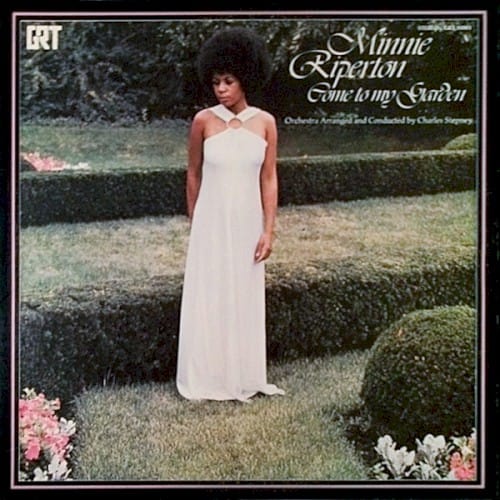
Minnie Riperton’s debut is a hallucinatory soul suite where Charles Stepney’s orchestral arrangements lift her five-octave voice into something that feels less like an album and more like a private seance. Essential for anyone who thinks they know 1970s R&B—this is the blueprint before the radio hits.
The first time you hear “Les Fleur,” it hits you somewhere behind the sternum. A piano figure that sounds like it’s being played underwater, then Minnie’s voice drifting in from another room—not quite a whisper, not quite a prayer. By the time the full string section surges in, you’re already gone. That’s the trick of Come to My Garden: it doesn’t ask for your attention so much as occupy the same air you’re breathing.
This was supposed to be the album that broke Minnie Riperton as a solo artist. She’d already logged years as a session singer and as the de facto lead of Rotary Connection, that strange psychedelic-soul collective Marshall Chess and Charles Stepney cooked up at Chess Records. But here, Stepney gave her space to be something else entirely. He wrote or co-wrote every track, produced the sessions, and arranged the strings and horns with a kind of European romanticism that most black pop in 1970 wouldn’t touch. The result is an album that sounds like it was recorded in a greenhouse at dawn.
Stepney had a dream about the arrangement for “Completeness.” That’s the story—he woke up, called Minnie, and told her he’d just heard the whole song in his sleep. They went into Ter-Mar Studios in Chicago with Ron Malo at the board, and the tape rolled. The session musicians were mostly Chess house-band regulars, plus some of Stepney’s guys from Rotary Connection. Maurice White played drums on a few cuts, including “Expecting.” That’s Phil Upchurch on guitar. Louis Satterfield on bass. The rhythm section is tight but loose, leaving room for the harp to float in and out like nobody told it the tune was supposed to end.
The engineering on this album is a masterclass in managing dynamics. Minnie’s voice could go from a purr to a high C above high C in a single syllable, and Malo had to ride the faders without making the tape hiss audible. On “Oh, By the Way,” her vocal climbs into the stratosphere during the bridge, and the string section swells to meet her—not fighting, but supporting. It’s a moment that will test your speakers’ ability to separate voices from strings. On a muddy system, it turns into noise. On good gear, it’s spine-tingling.
The album’s true centerpiece, though, is the side-long suite that takes up most of the original second side. “Come to My Garden” ushers you in with a harp glissando, then hands you over to “Memory Band,” which sounds like a New Orleans funeral march refracted through a prism. Minnie’s lyrics here are impressionistic—gardens, rain, faces in windows—but the emotion is plain. She’s singing about love as a place you can physically enter. The arrangement keeps shifting, strings giving way to woodwinds, then back to a lone piano.
Stepney never did anything quite like this again. He went on to produce Earth, Wind & Fire’s classic ’70s run, but Come to My Garden remains his most unfiltered statement. The album sold poorly on release—GRT Records was a mess, and the cover photo of Minnie in a sheer gown might have been a bit too suggestive for AM radio play in 1970. It took her later smash “Lovin’ You” in 1975 to send listeners crawling back to this record.
Twenty-five years after its release, DJ Shadow sampled “Memory Band” for “What Does Your Soul Look Like (Part 2).” Beck borrowed from “Les Fleur” for “Debra.” The album has quietly become a cornerstone of crate-digger mythology. But none of that matters when you put the needle down at 11 p.m. and the lights are low. What matters is the way her voice hangs in the air for three seconds after the last note fades.