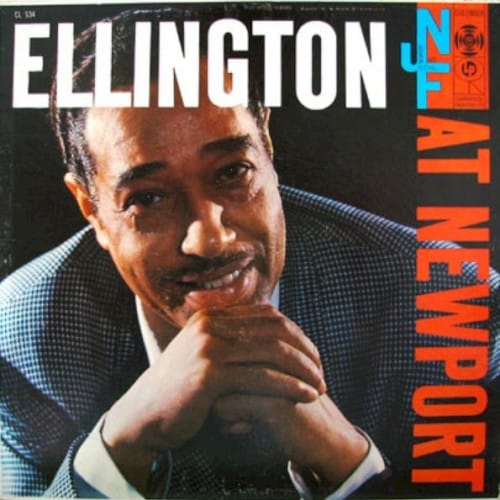
This is the live performance that saved Duke Ellington’s career—a single 27-chorus tenor sax solo turned a floundering set into a riot. The band is on fire, the crowd is screaming, and the recording still sounds like it’s happening in your living room. If you listen to one big band record, make it this one.
It had been a rough night for Duke Ellington. By the time his band took the stage at the Newport Jazz Festival on July 7, 1956, the crowd was restless, the weather was muggy, and earlier sets had fallen flat. This was supposed to be a comeback. The orchestra hadn’t had a hit in years, and the rock ’n’ roll wave was threatening to wash over everything. Then Paul Gonsalves stepped up.
The story is well-worn but never loses its power. After a slow, deliberate build through “Diminuendo and Crescendo in Blue,” Gonsalves—leaning back, eyes closed—unleashed a 27-chorus tenor sax solo that stretched for what felt like an eternity. The crowd lost its mind. Women danced in the aisles. A mysterious blonde later dubbed “the Newport girl” rose from her seat and started dancing alone, pulling the entire audience with her. The solo didn’t stop. It kept climbing, honking, swinging, until the band crashed back in and the whole tent seemed to lift off the ground.
The night that changed everything
The recording captures that chaos beautifully. You can hear the crowd surge, the band’s roar after Gonsalves finally hands off, and Ellington’s piano signaling the next section. Columbia’s engineers—led by the legendary George Avakian, who produced the set—kept the microphones hot and the levels honest. The result is a live document that doesn’t clean up the mess. It is the mess. When the final note rings out, the ovation lasts nearly a minute.
What gets overlooked is the rest of the set. Johnny Hodges’s alto on “I Got It Bad (and That Ain’t Good)” is so soft it feels like a secret. Cat Anderson’s trumpet pierces the air on “The Jeep Is Jumpin’.” And the rhythm section—bassist Jimmy Woode, drummer Sam Woodyard, and Ellington himself—locks into a groove that never relents. They were a road-tested machine capable of swinging like nobody else.
This album is not just a historical artifact. It’s a display of what a great live recording can do: put you in the room. You feel the heat, the sweat, the almost desperate energy of a band that knew this was their last chance. And when Gonsalves hits that thirty-second chorus—yes, he kept count—you understand why people still talk about it sixty years later.
The original LP release was a miracle of editing. Avakian had to splice together two performances of “Diminuendo and Crescendo in Blue” because the second night’s solo was even better. He used the first night’s intro and the second night’s solo. Cheating? Maybe. But it made the record immortal.
Put this on loud. Not polite loud—room-shaking loud. Let the brass rip through your speakers. Hear the crowd whistling. Then sit in the silence after it ends. That’s the sound of a career resurrected.