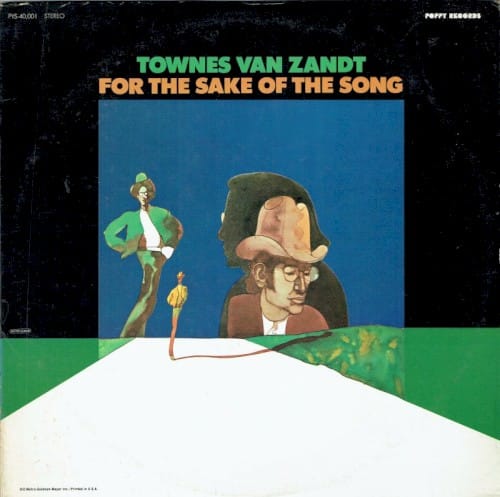
Townes Van Zandt's debut is a stark, poetic folk album that established his voice as one of country music's most haunting songwriters. Raw, intimate, and deeply melancholic, it matters because it contains seeds of every subsequent classic he would write. If you care about lyrical depth and human wreckage, hear it.
The first time you hear Townes Van Zandt, something cracks open. It might be a rib, or the seal on a bottle you didn’t know you were holding. For the Sake of the Song arrives in 1968 like a letter from a man who has already read the ending and is just writing it down for you anyway.
Recorded at Bradley’s Barn in Mount Juliet, Tennessee, over a handful of sessions in early 1968, this was the debut that would define a career nobody was ready for. The producer was Jack Clement, the same man who had wrangled Johnny Cash’s sessions and helped birth the Nashville sound. Clement knew talent when he heard it, but he also knew polish. He brought in session players you’d hear on a hundred other records: Jerry Carrigan on drums, Norbert Putnam on bass, Hargus “Pig” Robbins on piano. Charlie McCoy came in with a harmonica.
But the album never sounds like Nashville. It sounds like a man sitting alone in a room with a guitar, with a few strangers who were smart enough to stay quiet. Clement’s arrangements are tasteful—a light string section on the title track, some brushed snare—but they never overwhelm the voice. That voice, thin and fragile, cracks in places you don’t expect. It makes you lean in.
The Songs
The album opens with its title track, a waltz that sounds like it was written in a bar after last call. Townes was twenty-three when he cut it, but he sings like a man twice that age, haunted by something he can’t name. The song’s narrator is trying to explain himself to someone who has already walked out the door. You get the sense he’s done this before.
“Waitin’ Around to Die” is the centerpiece, a two-and-a-half-minute punch to the chest. It’s just Townes and his guitar, recorded live in the studio. Clement must have known better than to add anything. The lyrics chart a life of abuse, addiction, and despair so plainly that it feels like overhearing a confession. “Sometimes I don’t know where / This dirty road is taking me.” There is no artifice here. Just a man who has been to the bottom and is reporting back.
“Tecumseh Valley” follows a similar path, a story song about a woman named Caroline who loses everything, including herself. Townes’s delivery is almost too gentle for the material. He sings about her death the same way he sings about rain: it just happens. The album’s other tracks—“Sad Cinderella,” “Lungs,” “Our Mother the Mountain”—all circle similar themes of loss, addiction, and the strange beauty of hitting rock bottom.
Clement later said he thought the album was “too sad” to sell. He wasn’t wrong. It didn’t sell. But that wasn’t the point.
There is a particular loneliness in the way Townes stretches a word. On “Second Lover’s Song,” he hangs on a syllable until it becomes a sigh. The session guys hold back, letting the air in the room carry the weight. You can hear tape hiss between tracks, the sound of a reel being changed, someone clearing their throat. The album breathes like a living thing.
Engineer Jim Malloy set up a single Neumann U47 in the center of the room, a technique Clement had used for years. It gave the sessions a round, warm midrange that makes the guitar sound like it’s in the same room as you. Modern digital transfers have cleaned up the noise floor, but the original mono mix still holds a kind of dusty grace. Listen to it on a decent pair of headphones and you’ll hear the wood of the guitar before the strings.
The album closes with “Black Widow,” a track that could have been a throwaway but isn’t. Townes’s fingerpicking is precise, almost frantic, and his voice pushes against the rhythm like he’s trying to outrun the song itself. It fades out too soon, as if the tape ran out or he just didn’t have anything left to say.
And that’s the album. Twelve songs, thirty-eight minutes, recorded by a man who was already living the life he was writing about. He would go on to write even better songs—“Pancho and Lefty,” “If I Needed You”—but he never made a more honest record than this one. For the Sake of the Song is not a masterpiece in the polished sense. It’s a document. You don’t listen to it for comfort. You listen to it because it tells the truth.