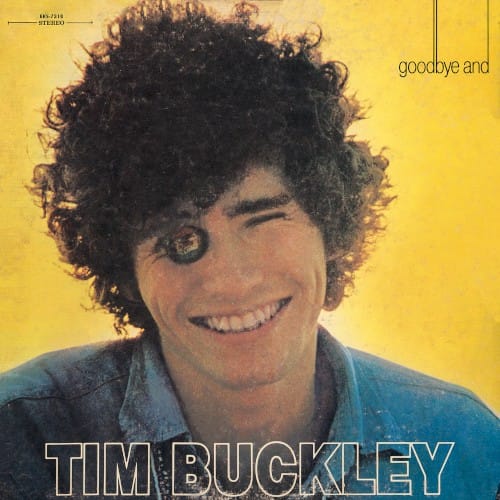
Tim Buckley's *Goodbye and Hello* is a folk-rock masterpiece that stretched his voice and vision beyond the coffeehouse. It matters because it captures a young artist shedding his skin in real time. If you care about singing as an instrument, hear this.
They say you’re only as good as your second album. Tim Buckley was twenty years old when he made this one, and he’d already outgrown the first.
His debut, Tim Buckley, was a gentle introduction — acoustic, earnest, full of Greenwich Village troubadour moves. Goodbye and Hello is something else entirely. It’s the sound of a young man discovering he has more range than he knows what to do with, and deciding to use all of it at once.
Recorded at Sunset Sound Recorders in Hollywood during the spring of 1967, the album was produced by Paul Rothchild, who had his hands full that year. The same studio, same engineer (Bruce Botnick) — and Rothchild was also producing The Doors that summer. But Buckley’s sessions were quieter, stranger, more vulnerable. Rothchild later said Buckley would walk in and just start singing, unaccompanied, and they’d build the arrangement around whatever he did.
The title track clocks in at over six minutes. It opens with fingerpicked nylon-string guitar, then the strings slide in, then Buckley’s voice ascends into something almost unearthly. He sings about the war in Vietnam, about God and time, and by the end he sounds like he’s standing in a cathedral with his arms stretched wide. It’s not a protest song — it’s a meditation that happens to be on fire.
Lee Underwood’s guitar work here is masterful in its restraint. He knew not to crowd the voice. John Miller’s bass stays low and warm, anchoring everything. And the orchestral arrangements — credited to Perry Botkin Jr. — are tasteful but not timid. They swell during the crescendos and recede when Buckley’s voice needs room.
“I Never Asked to Be Your Mountain” is the devastating center of the album. It was written for Buckley’s infant son, Jeff — the same Jeff Buckley who would record Grace three decades later. Tim sings about leaving, about knowing he’s not fit for parenthood, about the road ahead. The track runs nearly five minutes, and by the end his voice cracks with something that sounds like real shame. He was twenty years old. What twenty-year-old can sing leaving like that?
Side two opens with “Once I Was,” maybe the most straightforwardly beautiful song he ever wrote. An acoustic guitar and a voice, no tricks. The lyric is simple: “Once I was a soldier, and I fought on foreign sands for you.” But he doesn’t romance the memory. He sings it like a man who knows the war is not over.
The album closes with the title track. A last, long breath. The strings fade. The voice fades. And then silence.
The Voice Itself
You cannot talk about this album without talking about the voice. Buckley had a baritone that could leap into a full-throated tenor without breaking. He used vibrato like a painter uses a dry brush — sparingly, for texture. And he never seemed to be straining. Even when he wails on “Pleasant Street” or the harrowing “Hallucinations,” it sounds like the voice is exactly where it wants to be.
Some singers push. Buckley just opened his mouth and let it out.
Later, on Starsailor and Lorca, he would go fully experimental. But here the avant-garde impulses are held in check by melody and structure. He’s still writing songs you can hum. For now.
What Remains
Goodbye and Hello was not a massive commercial success, but it found its audience. It sold enough to keep Buckley on Elektra, and it earned him a cult following that never entirely went away. Critics at the time didn’t quite know what to make of it — folk? psychedelia? art song? — but they praised the voice.
Forty years later, you hear it in the way Jeff Buckley sang “Hallelujah.” The same trembling high notes, the same willingness to go where the melody demands. You hear it in Rufus Wainwright, in Antony Hegarty, in every singer who isn’t afraid to sound vulnerable.
Put the record on. Late at night. Listen to “Once I Was” and let it sit. Then watch the room change.