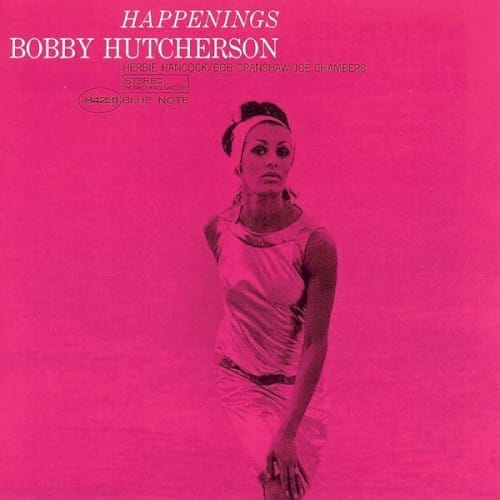
Bobby Hutcherson's *Happenings* is the sound of Blue Note's avant-garde wing hitting its stride — vibraphone as lead voice, Herbie Hancock comping like he's got something to prove, and a rhythm section that breathes fire. If you think jazz in 1966 was polite, start here.
The first time I heard “Maiden Voyage,” I thought my turntable was tracking a bit too warm — took me three tracks to realize that’s just how Bobby Hutcherson makes the vibes feel. On Happenings, recorded February 8 and 9, 1966, at Rudy Van Gelder’s Englewood Cliffs temple, the air itself seems to shimmer.
Alfred Lion produced. He always knew when to push and when to step back.
Hutcherson brought four originals and one standard — “You Don’t Know What Love Is” — and the session burns with a specific kind of 1960s Blue Note confidence. The man behind the mallets had been on the label for three years at this point, already a sideman on classic sessions with Eric Dolphy, Jackie McLean, and Andrew Hill. But here he steps forward, and the band follows him into corners that shouldn’t work but do.
Joe Chambers wrote “The Book’s Beat” and drums on it like he’s trying to spell something. Herbie Hancock’s piano on that track is the kind of interplay that makes you wish every trio had a fourth limb.
The Band That Heard Everything
The record opens with “Aquarian Moon,” and within ten seconds you know this isn’t just another date. Hancock drops a series of fourth-based voicings that sound like they’re floating somewhere between Debussy and outer space. Hutcherson matches him with long, ringing vibraphone tones that seem to hold in the air longer than physics should allow.
Bob Cranshaw’s bass is the anchor — steady, never rushing, but always leaning into the next phrase. Chambers rides the cymbal with a looseness that’s deceptive. Listen to the way he accents behind Hutcherson’s solo on “Bouquet” — he’s almost playing counter-melody, but he never steps on the vibes.
That’s the trick of this album. Everyone is listening.
There’s a moment on the title track where Hutcherson sustains a single note for nearly a full measure, and the entire band pulls back to let it decay. You can hear the room. You can hear the 65-watt tube amps in the control room. Rudy Van Gelder’s setup was famously clean — he used an Altec 1567A tube mixer and Neumann U67 microphones — but he knew when to let a room breathe.
The Sound of Leaving You Alone
The second side opens with “Rojo,” a Chambers composition that could have been a throwaway modal workout in lesser hands. Instead, it’s the album’s most dangerous track. Hancock plays a two-fisted left-hand figure while Hutcherson’s right hand dances across the bars. The recording captures the vibraphone’s sustain pedal perfectly — you hear the mechanics of the instrument as much as the melody.
This is not a cold, sterile Blue Note record.
It’s warm in that way that only a properly set-up tube system can deliver. The stereo imaging is wide but not exaggerated. The vibraphone sits slightly left of center, Hancock’s piano fills the right channel, and Cranshaw’s bass is dead center with just enough warmth to fill a good pair of floorstanders.
I’ve heard “Happenings” on a friend’s system with a Conrad-Johnson tube preamp and Vandersteen speakers, and the soundstage opened up like a live hall. But I’ve also heard it through a modest pair of nearfields in a bedroom, and it still works. That’s the mark of a great recording: it doesn’t punish you for wanting to listen on a rainy Tuesday night when the amp’s just been on for twenty minutes.
The track “You Don’t Know What Love Is” closes the album. It’s a standard, yes, but Hutcherson plays it like a man who has looked at love and walked away. No vibrato on the head — just pure, clean attack. Hancock comps behind him with single notes, leaving space for the vibes to breathe. Chambers uses brushes. It’s the gentlest moment on the record, and it lands harder because of everything that came before.