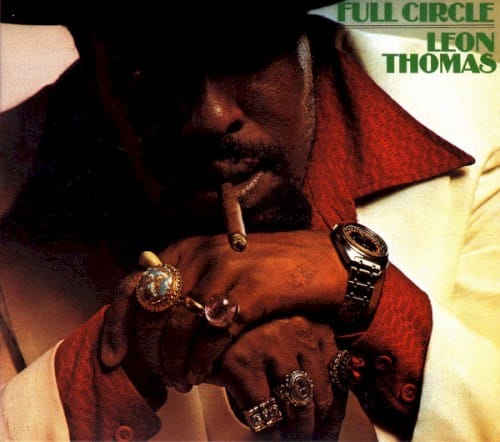
Leon Thomas's 1973 "Infinite Search" showcases a voice of extraordinary range—shifting fluidly from lyric baritone to African yodeling techniques—over cosmic jazz arrangements by Lonnie Liston Smith. Produced by Bob Thiele on Flying Dutchman Records, the album centers on the anti-war piece "Damn Nam," where Thomas channels spiritual resistance through techniques predating blues and jazz. Essential for listeners seeking adventurous vocal jazz and experimental spirituality.
There is a moment near the end of "Damn Nam (Vietnam)" where Leon Thomas stops singing and starts something else entirely — something older than jazz, older than the blues, something that sounds like it came up from the ground before anyone had a word for it.
Infinite Search arrived in 1973 on Flying Dutchman Records, Bob Thiele's independent imprint, the label that had given Pharoah Sanders a home and didn't flinch when the music got long and strange. Leon Thomas fit perfectly. He had come up through Count Basie's band, spent years as a journeyman vocalist, and then found himself inside the Impulse! orbit, recording Spirits Known and Unknown with Pharoah in 1969. That collaboration cracked something open. By the time he made Infinite Search, Thomas had developed one of the most singular voices in recorded music — a voice that could slip from lyric baritone into yodeling ululation mid-phrase, and make it feel inevitable.
The Room It Was Made In
The sessions came together in New York, produced by Thiele himself, a man whose ear for what mattered in jazz was simply not arguable — he had produced Coltrane's A Love Supreme. The band assembled around Thomas was deep. Lonnie Liston Smith was on piano, already developing the cosmic jazz-funk he would later take to Expansions. Carlos Garnett brought his tenor saxophone, James Mtume contributed percussion, and the whole thing was anchored by a rhythm section that understood restraint as a form of intensity.
The engineering gave the record a warmth that a lot of spiritual jazz from this period sacrificed for volume or vibe. Thomas's voice sits in the center of the mix with room around it, not buried in reverb, not pushed forward until it bleeds. You can hear him breathe.
What the Voice Does
The yodeling — and you have to call it that, because Thomas himself called it that — comes from Central African pygmy music, specifically the practice of hindewhu, which he had studied and absorbed with genuine rigor. This was not exoticism. It was vocabulary, earned and integrated. On "I Love You," it appears almost shyly at first, then opens into something ecstatic.
The album is not an easy listen in the sense of background music. It demands that you be in the room with it. Put it on when the house is quiet.
"Damn Nam" is the centerpiece and it is not subtle about its intentions. Thomas was singing against the war with the same directness Gil Scott-Heron and The Last Poets brought to spoken word, but routed through this otherworldly instrument of a voice, accompanied by electric piano and percussion that lock into a kind of incantatory groove. It does not resolve. It ends the way certain things end — not finished, just stopped.
Lonnie Liston Smith's playing throughout deserves more attention than it usually gets in discussions of this record. He is not soloing for glory. He is building a room for Thomas to move around in, choosing notes that open space rather than fill it. It's some of his most considered work.
Infinite Search never got the audience it deserved in 1973. Flying Dutchman was an indie with limited distribution, and spiritual jazz was already beginning its long exile from mainstream attention. The record was reissued by BGP in the nineties and found a second life in the crates of DJs who understood that its samples were sacred objects. Still, the album itself — the complete thing, played front to back — remains one of those quiet monuments that rewards everyone who finds it.