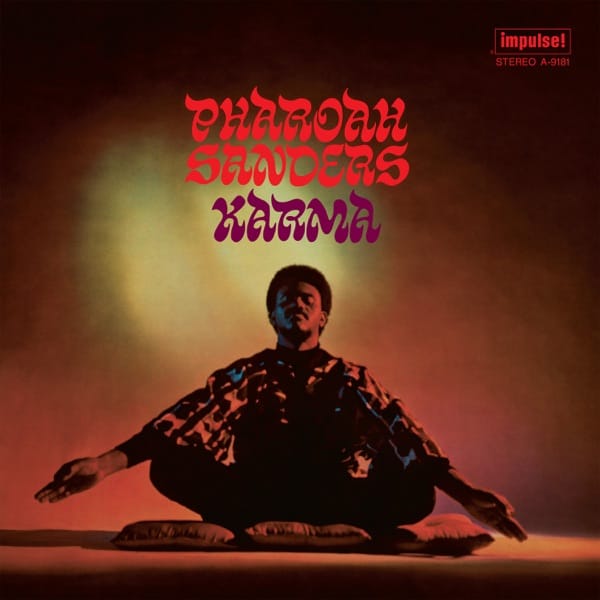
Pharoah Sanders' 1971 Impulse! release is a spiritual jazz masterpiece that balances ecstatic free playing with meditative stillness. Featuring Lonnie Liston Smith and Roy Haynes, it's an essential document of the post-Coltrane avant-garde. Sanders' tenor cries with a tenderness that cuts through the decades.
The first thing you notice about Kawaida is the space. Not the silence between notes, though that’s there too, but the room Sanders carves out for each musician to breathe. This isn’t the dense, spiraling fire of Karma. It’s later. Lighter. Sanders had already made his statement with “The Creator Has a Master Plan.” Now he was moving toward something quieter, something that didn’t need to prove its spirituality by volume.
Recorded at A&R Studios in New York during the spring of 1970, the sessions were engineered by Don Hahn, who had worked on Coltrane’s Ascension and Meditations. Hahn knew how to capture a saxophone in a room. You can hear it on “A Prayer for Peace” — the tenor is right there, breath and reed and the slight metallic ring of the bell. Sanders plays alto on this one, too, and the switch changes everything. Alto is a sharper blade. He uses it to cut through the gauze of Lonnie Liston Smith’s electric piano.
The rhythm section is ridiculous. Cecil McBee on bass, Roy Haynes on drums. Two giants who understood that free jazz didn’t mean loose. Haynes, especially, plays with a suspended animation — cymbals sizzling like rain on a hot sidewalk, snare cracks that arrive exactly when they need to. He never overplays. Neither does McBee, whose lines walk the line between root notes and abstraction.
Then there’s James Spaulding on alto and flute, and Steve Turre on trombone and conch shells. The conch appears on “Hum-Allah-Hum,” a track that feels like a dawn ceremony. Sanders chants the title phrase in a deep, unhurried baritone, and the horns answer in long, vibrating tones. It’s the most meditative moment on the album, and the most exposed. No chord changes. Just breath and intention.
The title Kawaida refers to the Swahili word for “tradition,” and Sanders was part of a larger movement — the Association for the Advancement of Creative Musicians, the Black Arts Movement, the work of Maulana Karenga. But the album isn’t didactic. It doesn’t lecture. It simply is a tradition: the long, searching saxophone solo, the collective improvisation, the hymn-like head. Sanders understood that spirituality in jazz isn’t about what you say. It’s about what you let yourself become in the moment.
Listen to the tenor solo on the title track. It starts in the upper register, a cry, then drops into the horn’s throat. Sanders bends notes like a blues singer. He holds one note for what feels like a full minute, letting it waver, letting the room ring. McBee locks into a two-note vamp. Haynes brushes the ride cymbal. The whole thing could fall apart at any second, but it doesn’t. That’s the magic — the risk, the trust.
This album never sold like Karma. It doesn’t have a single track that became a jazz standard. But for those who dig deeper, Kawaida is where Sanders’ vision coheres. He stopped reaching for the heavens and started listening to what was already there.
The reissues on Impulse! (the 2017 vinyl and the recent Verve/UME remasters) do the album justice. You can hear the analog warmth, the slight tape hiss, the way the piano sits just behind the sax in the left channel. It’s a record made by people who knew how to listen.
Put it on at night. Let the first track start. And don’t be afraid of the silence.