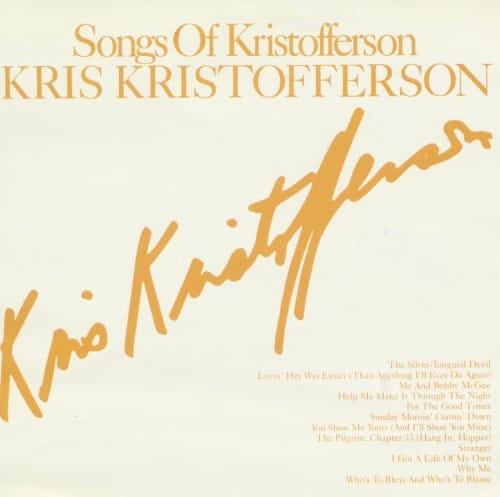
Kris Kristofferson's debut is a stark, weary set of songs that would become country and pop standards. He wrote them while working as a janitor at Columbia Studios. The voice is raw, the melodies sturdy, and the weariness genuine. This album made him a legend before he ever had a hit of his own.
Before he flew helicopters for the Army, before he swept the floors at Columbia Studios hoping someone would listen to his songs, Kris Kristofferson had already packed more lives into one body than most of us ever will. By 1970, he was thirty-four, an age when most debut albums arrive with the scent of desperation or last-chance stubbornness. Kristofferson has both.
Fred Foster produced the sessions at Monument Recording Studio in Hendersonville, Tennessee, with additional work at RCA’s Nashville studio. The band was a who’s-who of Music Row session pickers: Charlie McCoy on harmonica, Jerry Kennedy and Wayne Moss on guitars, Norbert Putnam on bass, and Kenneth Buttrey on drums. These were the guys who played on Dylan’s Blonde on Blonde and Simon & Garfunkel’s “The Boxer.” They knew how to stay out of the way.
And that was the assignment. Kristofferson’s voice is not pretty. It cracks, it gasps, it falls off pitch in the middle of a word. But that’s the point. This isn’t a record about polish; it’s about the weight of a life lived hard. “Me and Bobby McGee” debuted here in a version that sounds like a field recording compared to Janis Joplin’s freight-train howl. But listen closer: Kristofferson’s reading carries a different ache, the regret of a man who outlived the moment.
“Sunday Mornin’ Comin’ Down” earned him the Country Music Association’s Song of the Year in 1970, performed by Johnny Cash. Kristofferson’s own version is hushed, almost uncomfortable. You hear the hangover. You smell the stale coffee. The line about “wishing, Lord, that I was stoned” slipped past the censors because nobody believed a Rhodes Scholar with an Army record would write something that honest.
The album’s centerpiece is “Help Me Make It Through the Night.” Sammi Smith would take it to No. 1 on the country charts in 1971, softening the edges. Here it’s fragile, a plea whispered into a dark room. Kristofferson sings it like a man who’s already asked for help too many times. The pedal steel—played by Pete Drake? Actually, it’s John Hartford on fiddle and Buddy Spicher on steel, depending on the track—hovers in the background like a fog.
Structurally, Kristofferson moves like a barroom conversation. The songs were written over years, some in a shed behind the house he shared with his first wife, some on bar napkins. “For the Good Times” became a massive hit for Ray Price, but here it’s stripped to a guitar and a sigh. There’s no studio trickery. Foster kept the arrangements minimal because the words didn’t need help.
The album runs just over thirty-three minutes, which feels about right. Any longer and the emotional gravity might collapse into melodrama. As it stands, Kristofferson is a document of getting by. Not triumph, not despair—just the middle ground where most of us live.
The outlier is “The Law Is for the Protection of the People,” a protest song that drifts into political territory Kristofferson would visit more aggressively later. It’s the weakest track, not because the sentiment is wrong but because the posture doesn’t fit him. He was never an angry young man; he was a tired one.
What remains is a debut that sounds like a final statement. Kristofferson had been writing for a decade before this record. He had nothing left to prove and nowhere to go but up. That freedom gives Kristofferson its odd, unhurried authority. It’s not a masterpiece in the flashy sense. It’s a room with a single bulb, a chair, and a man telling you what happened.