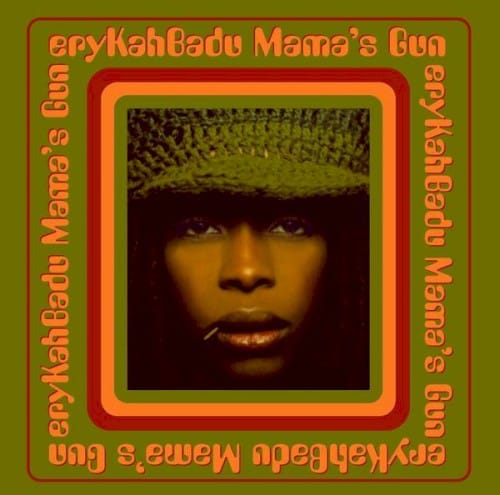
Erykah Badu's second album is a slow-burning masterpiece of neo-soul, recorded in New York and Dallas with the Soulquarians. It expands her debut's sound with jazz harmonies and deeper introspection. Essential for anyone who thinks soul music peaked in the 70s.
The first thing you hear on Mama’s Gun is breath. Not a beat, not a sample—just Erykah Badu exhaling into the microphone before “Penitentiary Philosophy” clicks into its lazy, finger-snapping groove. That breath is trust. She knows the band will catch her, and they do.
Recorded across Electric Lady Studios in New York and Dallas Sound Lab in 2000, the album is the sound of the Soulquarians collective at full stretch. These were the sessions where Questlove’s snare drum learned to sigh, where D’Angelo would lean into a Rhodes piano and let a single chord hang in the room for minutes. James Poyser was at the boards. Pino Palladino’s bass is so deep you feel it in your chest. Roy Hargrove brought his flugelhorn to “Didn’t Cha Know” and turned it into something close to a prayer.
Badu was pregnant with her second child during these sessions. You can hear it in the way she leans on words, stretches them into new shapes. “Orange Moon” floats on a bed of harmonium and strings. “Apple Tree” recasts her own early single with a slower pulse and a bigger room sound. Nothing here is in a hurry.
Engineer Tom Schick captured the room at Electric Lady the way you’d photograph a familiar face at dawn. The tape hiss is present. The piano stool creaks. The horns are placed with care—not on top of the voice, but wrapped around it. Listen to “Time’s a Wastin’” on good headphones: the acoustic guitar is parked slightly left, the Fender Rhodes drifts across center, and Badu’s vocal sits just in front, never above. That’s an engineer who knows how close a singer can get before it feels like a whisper you weren’t meant to hear.
The album’s centerpiece, “Didn’t Cha Know,” begins with a bass harmonic that sounds like a question nobody asked. Then Hargrove enters, and the whole thing opens up. It’s the best song she’s ever written. I’ll say that plainly.
But the strangest moment comes at the end. “Green Eyes” runs nearly eleven minutes, a slow-burn build that collapses into a spoken-word outro about emotional freedom. Badu talks directly to the listener—no filter, no metaphor. It’s uncomfortable the way real honesty always is. Most artists would have faded it out. She lets it breathe until it stops on its own.
This is an album you live inside, not one you listen to on a commute.
The original CD master is punchy and hot, but the vinyl pressing from the early 2000s is cut with more dynamic range. If you can find an original, grab it. The reissues are fine, but they lost some of the low-end weight that makes Bag Lady hit like a deadline you can’t avoid.