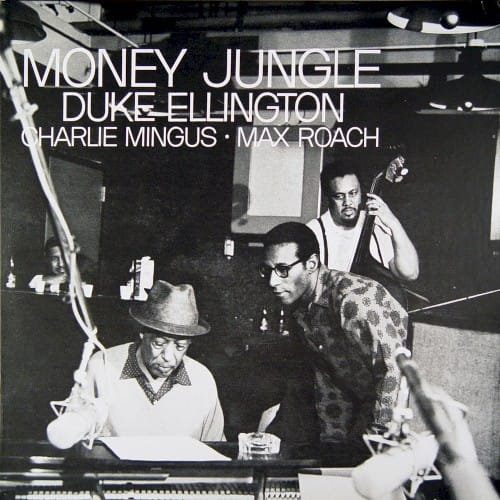
A volatile 1962 trio session pairing Duke Ellington with Charles Mingus and Max Roach. The tension is palpable, the playing fierce. This is Ellington pushed beyond his usual elegance into raw, confrontational territory. Essential for anyone who thinks jazz was always polite.
The first take of “Money Jungle” sounds like a car crash that somehow keeps the wheels turning. Ellington stabs at the keys, Mingus bows his bass like he’s trying to file a lawsuit, and Roach—god, Roach—hits the drums with the fury of a man who just realized he’s late for his own revolution. This was never going to be background music.
In September 1962, Ellington walked into United Recording in Hollywood with no orchestra, no horns, no safety net. Just a piano, a bass, and a drum kit. The engineer was Bill Putnam, a man who had already shaped the sound of modern recording with his work on Sinatra and the Beach Boys. He set up the trio live in the room—no baffles, no separation. You can hear the wood of Mingus’s bass resonate off the walls. You can hear Ellington breathing.
The Session
Alan Douglas produced the dates, and he later said the air in the studio was thick enough to cut. Mingus had arrived with an agenda: he wanted to prove that the Duke could still swing hard, that he wasn’t just a blazer-wearing bandleader for the country club set. But Mingus was also a control freak, and Ellington—well, Ellington had been running sessions since Prohibition. Two alpha males in a room with a drummer who could outplay them both.
The result is a record that feels like a live wire. “Money Jungle” itself is built on a loping, almost funky bass line that Mingus locks into while Roach drops bombs around the snare. Ellington’s comping is all angles and elbows—none of the velvet touch you’d expect from “Mood Indigo.” He’s pushing, testing the limits of the trio format. On “Caravan,” he turns his own classic inside out, stripping the melody to bones and letting the rhythm section rebuild it from the ground up.
You can hear Mingus swearing under his breath on “Very Special.” Or maybe that’s just the strings groaning.
The engineers captured it all with astonishing clarity. Putnam’s use of a single overhead microphone on the drums gives Roach’s cymbals a shimmer that no modern plugin can fake. The piano is tight and present, not washed in reverb. This is an album that rewards good gear—a revealing set of headphones or a clean phono preamp will let you hear the scrape of Mingus’s thumb on the gut strings.
Ellington never made another record quite like this. He went back to his orchestra, back to the suites and the stage shows. But for two days in Hollywood, with two men who refused to give an inch, he made something that still sounds like a risk. That still sounds like a fight. And that still swings harder than almost anything else in his catalog.
The record ends with “A Little Max (Parfait),” a waltz that feels almost reluctant to leave. Roach brushes the drums softly. Mingus walks a line that could be a lullaby. Ellington plays a few chords that hover in the air like smoke. And then it’s over. You sit there in the silence, wondering what else they might have done if they’d just stayed in the room a little longer.