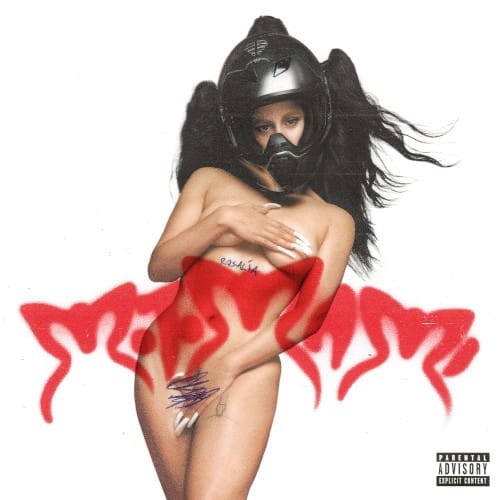
No pop record this decade has sounded this unhinged, this precise, or this personal. Rosalía dismantles reggaeton, flamenco, and bachata into a mosaic of voice memos, Auto-Tune stutters, and sampled engine revs. It rewards headphones that don't flinch at the extremes.
If Rosalía’s El Mal Querer was a thesis, Motomami is the thesis defense where she sets the room on fire. That album followed a medieval narrative arc; this one follows the thread of a woman who spent years on a tour bus, half-asleep in hotel rooms, recording voice memos into her phone. The result is not an album so much as a document of what happens when a virtuoso decides to stop performing virtuosity and start performing fracture.
The sessions were scattered—Miami, Los Angeles, Barcelona, a garage in Puerto Rico converted into a makeshift studio. Noah Goldstein (a Frank Ocean and Radiohead veteran) co-produced several tracks, and the presence of long-time collaborator El Guincho is felt in the rhythmic abandon. But the real session drummer is the MPC. Rosalía said in interviews that she wanted “the sound of a hard drive crashing.” That’s not a metaphor: listen to the way “SAOKO” lurches into its chorus, the kick drum hitting like a slammed car door, the hi-hats clipped to a digital stutter. It’s percussive without being percussive—a beat programed by someone who knows flamenco palmas and reggaeton dembow in her bones and chose to shred them both.
The vocal production is the album’s real signature. On “Candy,” she layers her voice into a choir of wounded whispers, each harmony slightly detuned, as if the tapes were left in the sun. “Hentai” strips everything to a piano that sounds like a Casio sampled through a phone line. The lyric is explicit—body parts named without metaphor—and the delivery is so fragile that the song feels less like a performance and more like a confession you weren’t supposed to hear. That’s the Rosalía of Motomami: a woman who has mastered every tool in the studio and chooses to use them to make herself unprotected.
The album’s title is a portmanteau of “moto” and “mami”—Rosalía on a motorcycle, untethered. But the bike is never far from the listener’s ear. The revving engine that opens “Motomami” is a sample from a YouTube clip of a Ducati. She has said she recorded it on her phone and refused to clean it up. That fidelity—or lack of it—is the aesthetic north star. This is a record that sounds expensive and cheap in equal measure, like a luxury car with the doors welded shut and the windows painted black.
The Shape of Pop
There is a track called “Bulería” that lasts exactly two minutes. It has a bridge that sounds like a broken Siri reading a shopping list. It is one of the most thrilling pieces of pop music released this decade. The song builds on a single flamenco handclap pattern looped into a digital abyss, then Rosalía begins to spit bars in a flow that feels like free-association—nonsense syllables, brand names, a lyric about wanting to eat a dick (she sings it in Spanish, but the translation is direct). The beat drops out, comes back, drops out again. You cannot dance to it. You cannot sit still.
“Diablo” rides a dembow that is almost too fast, like a reggaeton track pressed at 45 RPM. The bass note is a low C that rattles the chest if you have a subwoofer capable of reaching that deep. But the real action is in the silence: the spaces between the kick and the snare are carved out with surgical precision, leaving room for Rosalía to slide in with a melody that sounds Arabic, flamenco, and vaguely like a ringtone from 2002.
End without a lesson. The album doesn’t teach you anything. It just exists, in all its fragmented, narcotic, maximalist glory. Put it on at night, in the dark, and turn it up until the clipped waveforms start to hurt. You’ll hear what she wanted you to hear: the sound of someone pressing gas and closing her eyes.