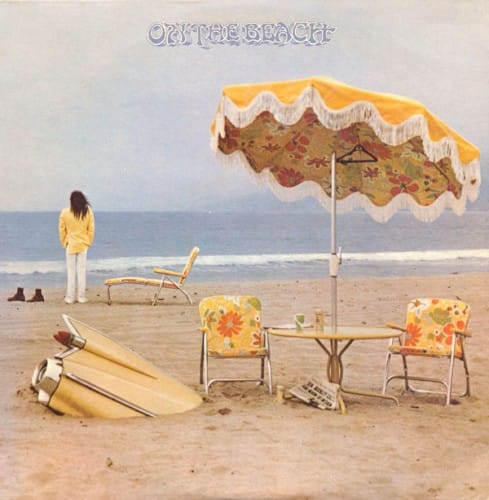
There's a moment three songs into side two where the whole thing just falls away. The guitar starts to sound like it's rusting in real time. And you realize nobody warned you this album would be the loneliest you'd ever buy.
By 1974, Neil Young had already made Harvest, the record that made him a stadium act whether he wanted it or not. He did not want it. The success, the money, the people who only wanted "Heart of Gold" — it all sat on him like a coat that didn't fit. On the Beach was his response. He made it in the same period as Tonight's the Night and Time Fades Away, the so-called "ditch trilogy," but this one is different. It's not a live howl. It's a studio record where he let the silence in.
The sound is strange — dry, midrange-heavy, like the band is playing in a room with no furniture. Ben Keith's pedal steel doesn't weep; it creaks. The drums sound like someone hitting cardboard boxes in the next room. The whole thing has the feel of an 8-track cassette left on the dashboard of a car in July.
The Genius of Mismatched Pieces
The album opens with "Walk On," a shuffle that sounds almost cheerful until you listen to the words. Then "See the Sky About to Rain" drifts in like weather you can't outrun. Side one ends with "Revolution Blues," a song so casually violent it makes Charles Manson seem like the subject of a news report Young is reading aloud. He sings it in that high, thin voice, like he's holding the paper at arm's length.
"Vampire Blues" is a slow, greasy blues number about the oil industry, if you can believe it. It works because Young never winks. He means every word.
Side two is where the album becomes something else. Title track "On the Beach" is nine minutes of sustained resignation, with lyrics that sound like overheard fragments from a man talking to himself on a bench. "Motion Pictures" is quieter still, almost a lullaby for people who can't sleep. And then "Ambulance Blues" closes the record — nine more minutes, fingerpicked acoustic guitar, lyrics that drift from personal regret to political despair to the weight of simply getting older.
I will say this plainly: "Ambulance Blues" is the best song Neil Young has ever written. Not the most famous. The best. It has no chorus. It barely has a structure. It just keeps going until it has said everything it needed to say, and then it stops.
The album was a commercial disappointment when it came out. It was received as an intentional snub to the audience Harvest had built. Young didn't seem to care. In the years since, On the Beach has become the entry point for people who want the real Neil — the one who makes records that feel less like products and more like dispatches from a man who genuinely might not make it to the next one.
No line of the album has ever haunted me more than this, from the last song: "It's hard to say the meaning of this song." He says it after nearly eight minutes of playing. It's the kind of line that makes you put the needle back and start over.