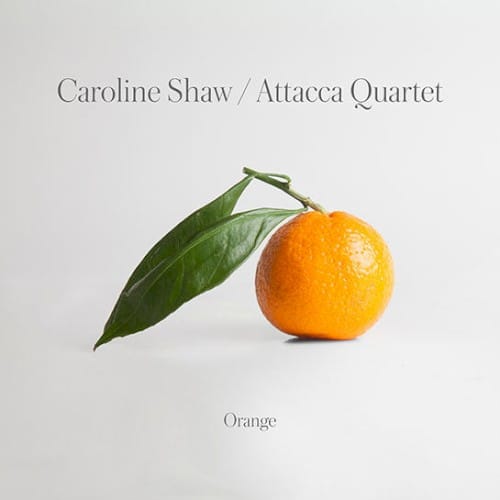
Caroline Shaw's *Orange* is a collection of vocal and string quartet miniatures that feel like overheard conversations in a dream cathedral. Classical music that breathes with pop's intimacy, sung by a composer who treats her own voice like another instrument. Essential for anyone who thinks contemporary classical is buttoned-up.
The first time I heard Caroline Shaw’s voice on Orange, I thought someone had left a window open to another century. There’s a grain to it, a slight southern warmth, that sits weirdly well with the Attacca Quartet’s immaculate intonation. She’s not a virtuoso singer — she’s something rarer: a composer who understands the micro-expressive power of the human voice.
Recorded at Oktaven Audio in Yonkers, engineer Ryan Streber captured the room’s natural bloom without smothering it in reverb. You can hear the bow hair catch on strings. You can hear Shaw’s breath between phrases. That closeness is the whole point.
The album’s title track opens with a single, held violin note that warps into a shimmering cloud as the quartet enters. Shaw’s voice floats above it, nearly wordless at first, then landing on syllables that aren’t quite language. It’s the sound of someone trying to describe a color. The piece Orange doesn’t resolve so much as dissolve — like watching the fruit’s skin gradient from rind to pith.
Valencia is the outlier. Written for four cellos, it starts with a cello quartet and Shaw’s harmonized voice, building into something that could pass for an art-pop single if you stripped away the context. The pulse is almost danceable. It’s the track I’d play for someone who insists classical music has no groove.
The engineering on Shaft of Light deserves special mention. Streber layered Shaw’s voice into a cluster that sounds like a pipe organ made of glass. Panning is used sparingly but precisely — a violin will lean hard into the left channel, then anchor back to center as the phrase ends. On a good system, you can feel the air shift.
This album was never going to be background music. Shaw’s Pulitzer for Partita in 2013 proved she could write for a room full of elite musicians. Orange proves she can write for one person listening alone in the dark. The pop sensibility she often mentions in interviews shows up in the economy of her gestures — nothing overstays, nothing under-develops. Each piece is four or five minutes of perfectly timed reveal.
The closer, Cant voi l’aube, takes a 14th-century troubadour melody and drops it into a harmonic bed that could have come from a 90s alternative record. Shaw sings the Occitan text with such conviction you almost forget you don’t understand a word. That’s the trick: she makes the unfamiliar feel inevitable.
I keep coming back to the way Its Motion Keeps ends — with a single voice trailing off over a slowly decaying electronic drone. The album has been building these complex, interlocking textures for forty minutes, and then it just lets go. There’s no grand finale, no summarizing chord. Just evaporation.
That’s the whole ethos of Orange. Build something intricate, let it live for exactly as long as it needs to, and then vanish before anyone can pin it down.