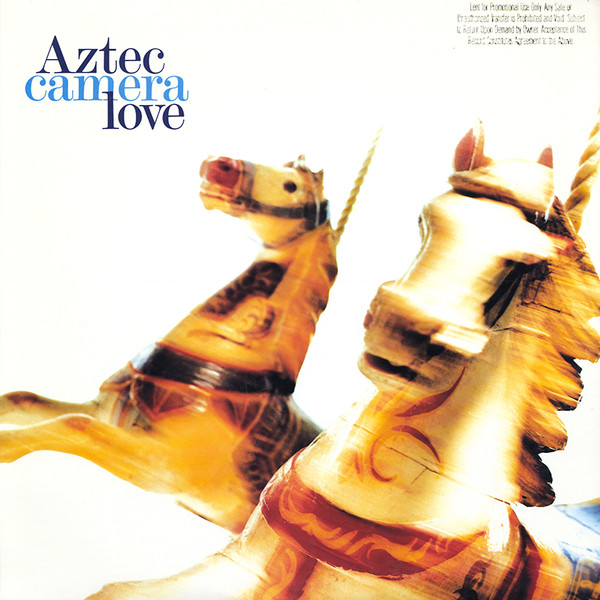
I’ve owned Aztec Camera’s Love for years without noticing who produced it. The album sounds like a Scottish pop band chasing R&B — which is exactly what Roddy Frame was doing in 1987, recording in New York, listening to WBLS, programming drum machines. He called it his Young Americans.
The producer credit on Love lists six names: Roddy Frame, Tommy LiPuma, Russ Titelman, David Frank, Michael Jonzun, and Rob Mounsey. Five of them are session professionals. One of them — Russ Titelman — produced some of the biggest records in my Eric Clapton collection.
Titelman produced Journeyman (1989), Unplugged (1992), and From the Cradle (1994). He also produced Steve Winwood’s Back in the High Life (1986), George Harrison’s self-titled 1979 album, Christine McVie’s solo debut, Paul Simon’s Hearts and Bones, and Rickie Lee Jones’ first two records. Three Grammy wins — one for Winwood’s “Higher Love,” two for Clapton.
He started in the 1960s as the rhythm guitarist in the house band on Shindig!, then studied sitar under Ravi Shankar. By the time Aztec Camera walked into the studio, Titelman had spent twenty years at Warner Bros. producing records for artists who could not sound more different from a Scottish jangle-pop band: Randy Newman, Ry Cooder, James Taylor, the Bee Gees.
The question is why Frame wanted him at all. The answer is in the sound. Love is not a folk-rock record. It’s a soul-pop album with session musicians — Steve Gadd on drums, Marcus Miller on bass, David Frank of the System on keyboards. Frame was chasing a specific groove, and Titelman was one of the few producers in the world who could deliver it while also making a record that still sounded like the guy who wrote “Oblivious.”
What strikes me is the distance between these two halves of my collection. I have thirty-odd Clapton albums. I have a handful of Aztec Camera records. They sit on the same shelf, and the same person made both of them. Titelman’s fingerprints are on Clapton playing blues covers at Olympic Studios in London, and on Frame programming drum machines in a New York studio a year earlier. The genres are opposite ends of the spectrum. The producer is the same guy.
That’s the thing about producers — they move between worlds that never overlap on the listener’s end. You’d never put “Somewhere in My Heart” and “Tears in Heaven” on the same playlist. But Russ Titelman made both of them.