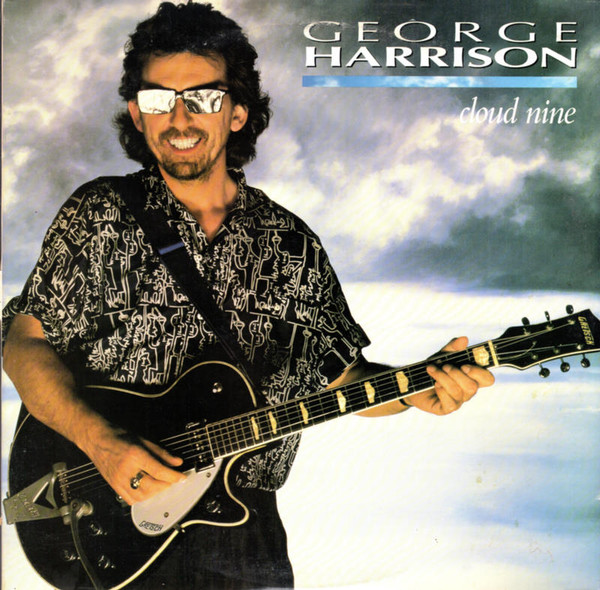
I was looking at the credits on George Harrison’s Cloud Nine when something I’d never noticed jumped out: Elton John played piano on three tracks. Not unusual in itself — Elton plays piano on a lot of records. But what caught me was the footnote in the Wikipedia article about the sessions: Elton was recovering from vocal cord surgery at the time. He couldn’t sing. He could still play, and Harrison wanted him there anyway.
Elton plays Fender Rhodes on the title track, “Cloud 9,” and piano on “Devil’s Radio” and “Wreck of the Hesperus.” According to Discogs, Ray Cooper — Elton’s longtime percussionist, the man who’s stood behind him on every tour since the early 1970s — also played drums and percussion on the album. So Harrison didn’t just borrow Elton. He borrowed Elton’s rhythm section.
The Room Where It Happened
Cloud Nine was recorded between January and August 1987 at FPSHOT, Harrison’s home studio in Oxfordshire. Harrison had been away from solo recording for five years — frustrated with the changing musical climate, he’d spent the early 1980s running Handmade Films instead. When he decided to make music again, he called Jeff Lynne.
Lynne was the co-producer, but that barely describes what he did. According to the liner notes, Lynne played bass, acoustic and electric guitars, keyboards, and synthesizers on the album, and co-wrote five of the eleven songs. He was everywhere.
Then there was Eric Clapton — electric guitar on four tracks. And Jim Keltner on drums. And Ringo Starr on drums and backing vocals. Harrison was not assembling a pickup band. He was calling his friends.
The Wilburys Were Already in the Room
Here’s the part that stops me. Within a year of finishing Cloud Nine, Harrison would call up Jeff Lynne, Bob Dylan, Tom Petty, and Roy Orbison and form the Traveling Wilburys. The first album came out in 1988. The second, after Orbison’s death, in 1990. A third followed in 1990.
But look at who was already playing together on Cloud Nine: Harrison, Lynne, Clapton, Elton John, Ringo Starr. Harrison essentially had the Traveling Wilburys in his living room before the Traveling Wilburys existed. The Wilburys added Dylan, Petty, and Orbison — three musicians who weren’t on Cloud Nine — but the collaborative energy was already there. The record sounds like a band. Because it was one. An informal one, playing under Harrison’s name, but a band.
And the timing is exact. Wikipedia says the Traveling Wilburys formed in the spring of 1988 — less than six months after Cloud Nine was released. Harrison had just spent eight months in a studio with some of the best musicians in rock. The Wilburys weren’t a new idea. They were the next idea.
The Collection as Evidence
I own albums by every musician who played on Cloud Nine. Harrison — sixteen albums. Jeff Lynne’s ELO — fourteen. Clapton — twenty-six. Elton John — over forty. Ringo Starr — over twenty. I own all three Traveling Wilburys albums. I own Tom Petty’s Full Moon Fever — the album Lynne produced the same year as Cloud Nine, playing bass, guitar, keyboards, and singing backing vocals on virtually every track. I own Bob Dylan’s The Basement Tapes and The Concert for Bangladesh. I own Roy Orbison’s 80s 100 Hits, which includes “You Got It.”
Cloud Nine sits at the center of all of it. Every name on the credits leads to another shelf in my collection. The album isn’t a solo record. It’s a node.
What “Got My Mind Set on You” Was Hiding
The hit single was “Got My Mind Set on You” — a cover of a 1967 song by Rudy Clark, originally recorded by James Ray. Harrison’s version reached number one in the United States, his first chart-topping single since 1973. It’s the song most people remember from Cloud Nine. The music video — stop-motion animation, Harrison’s head multiplying on a plate — was everywhere in 1987.
But the album isn’t about the single. It’s about the room. Harrison wrote or co-wrote ten of the eleven tracks. Lynne co-wrote five. Gary Wright — the “Dream Weaver” guy — co-wrote “That’s What It Takes” and played piano on two other songs. The album is Harrison’s voice, but the sound is collective. It has the warmth of musicians who like each other.
The Unlikely Detail
The detail I keep coming back to is Elton John playing piano while recovering from vocal cord surgery. It’s a small fact. It doesn’t change the album. But it tells you something about the sessions — that this was the kind of room where you showed up even when you couldn’t do your main job. Harrison wanted his friends around him. Elton came. Ray Cooper came with him. Clapton came. Ringo came. Keltner came. Lynne was there from the start.
Within six months, Harrison would call Dylan, Petty, and Orbison and start the Traveling Wilburys. The record that made that possible was Cloud Nine — the album where Harrison gathered the musicians, found the sound, and proved that playing together was better than playing alone.