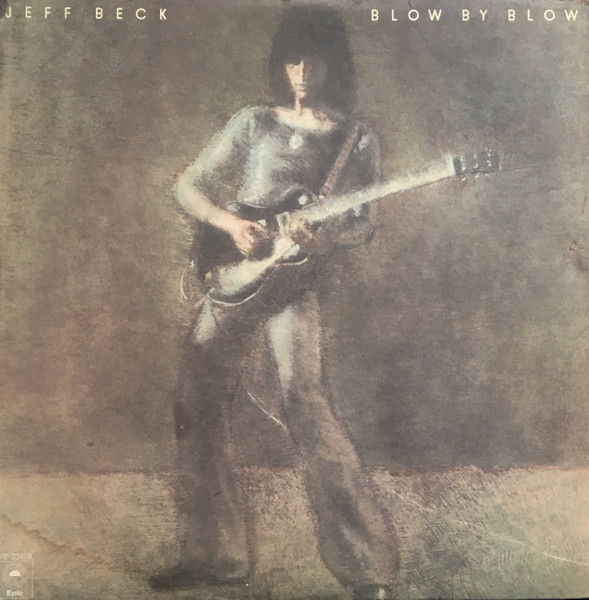
I have Jeff Beck’s Blow by Blow on vinyl. It’s the album where a guitarist who’d been playing blues-rock ruts for a decade suddenly made the best jazz-fusion record anyone had heard that year. I always assumed it was a creative left turn — Beck getting bored and trying something new.
It wasn’t. It was a consolation prize.
In 1972, Jeff Beck was at a crossroads. His power trio Beck, Bogert & Appice had collapsed. He’d cycled through three different bands since the Yardbirds and none of them had delivered a hit. He was tired of recycling the same blues-rock vocabulary. He admired Stevie Wonder’s music and wanted to work with him, so they struck a deal: Beck would play guitar on Wonder’s next album if Wonder would write songs for Beck’s project.
Beck went to Electric Lady Studios in New York to play on what would become Talking Book. During a break in the sessions, he sat behind a drum kit and started fooling around with a shuffle — the kind of absent-minded pattern you play when you’re killing time on an instrument that isn’t yours. Wonder walked in, heard it, and told him to keep playing. Then he started improvising on a Hohner Clavinet. The two of them built a song on the spot.
“Stevie came kinda boogying into the studio, ‘Don’t stop.’ ‘Ah, c’mon Stevie, I can’t play the drums.’ Then the lick came out. ‘Superstition.’ That was my song, in return for Talking Book. I thought, ‘He’s given me the riff of the century,’” Beck recalled in the biography Jeff Beck: Crazy Fingers.
He had. “Superstition” was supposed to be Jeff Beck’s song.
Then Motown got involved. Berry Gordy’s label heard the demo and wanted Wonder to release it as a single to anchor Talking Book. Wonder agreed. By the time Beck could rerecord his own version — delayed by band drama that included a studio altercation with his bassist, who was fired the next week — Wonder’s “Superstition” was already climbing the charts. It hit number one in January 1973.
“We were gutted, you know, totally,” Beck said. “We would have had a monstrous, monstrous hit.”
As a peace offering, Wonder gave Beck two other songs he’d written during the Talking Book sessions: “Cause We’ve Ended as Lovers” and “Thelonius.” Beck shelved his version of “Superstition” entirely.
Here’s where the story takes its strangest turn. Beck needed a producer for his next album. He chose George Martin — but not for the reason you’d think. He didn’t hire the Beatles’ producer because of “A Day in the Life” or Sgt. Pepper’s. He hired him because of Martin’s work on the Mahavishnu Orchestra’s 1974 album Apocalypse. Beck had been listening to jazz fusion — Billy Cobham, Stanley Clarke, John McLaughlin — and Martin’s production on Apocalypse was what convinced him the man could handle what he wanted to do.
Beck walked into AIR Studios in London in October 1974 and found Martin sifting through Beatles outtakes from the “A Day in the Life” sessions. “I got there and heard John’s voice — it was so clear, I thought maybe he’s still alive,” Beck later said.
He laid down a version of Wonder’s “Cause We’ve Ended as Lovers” with his three-piece band. “I didn’t think we were laying down much of interest, but then we went to lunch break and heard the quality of the sound,” Beck recalled. “I thought, ‘This sounds like we’re playing in the room — it’s clear and fabulous.’ That first album was a joy.”
The album was Blow by Blow. It hit number four on the Billboard 200 and went platinum — Beck’s biggest commercial success ever. He dedicated “Cause We’ve Ended as Lovers” to fellow guitarist Roy Buchanan.
And that’s the thing I keep coming back to. Jeff Beck lost “Superstition” — a song he’d accidentally invented on a drum kit during a coffee break, a song he called “the riff of the century.” He lost it to a label executive’s instinct for single-release timing. He lost it to bass-player drama. He lost it to the calendar.
And in exchange, he got an apology song from Stevie Wonder, a Beatles producer he’d hired for his jazz credentials, and the biggest hit of his career. Losing one of the most recognizable songs in the history of popular music turned out to be the best thing that ever happened to Jeff Beck. Blow by Blow didn’t just revive his career — it redefined what a guitarist could do without a singer.
I’ve owned this record for years. I never knew it existed because of a drum shuffle that got stolen.