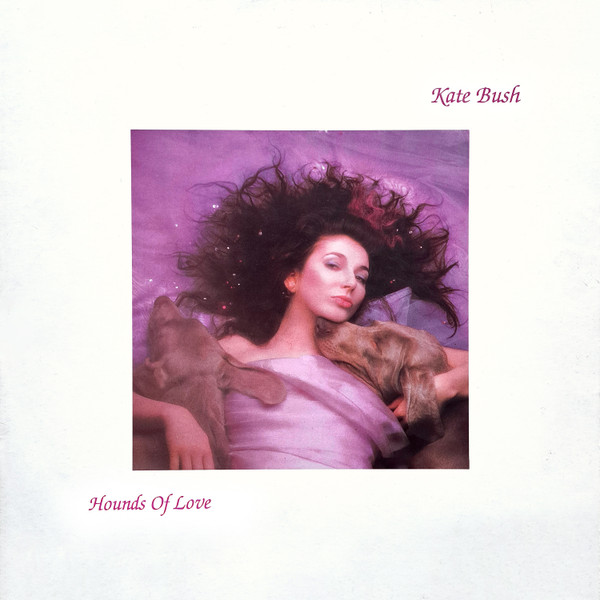
I was looking at the credits on Kate Bush’s Hounds of Love when I noticed a name I’d seen before — but in a completely different context. On “Watching You Without Me,” the fifth track on Side A, the double bass is credited to Danny Thompson.
Danny Thompson was the double bass player in Pentangle, the British folk-jazz band that existed from 1967 to 1973. He’d been playing double bass since the early 1960s, when he bought a French Gand instrument from 1865 for five pounds at a shop in Soho. He named it Victoria. He played it for the rest of his career.
But the connection that stopped me wasn’t Pentangle. It was Talk Talk.
Danny Thompson also played double bass on Spirit of Eden — the Talk Talk album that Mark Hollis recorded in a blacked-out studio over ten months, with musicians who were led in blind and asked to play without seeing each other. Spirit of Eden is in my collection. So is Hounds of Love.
Two albums that couldn’t sound more different. One is Kate Bush’s 1985 masterpiece — Fairlight synthesizers, Celtic instruments, Linn drum machines, pop melodies. The other is Talk Talk’s 1988 post-rock statement — improvised performances edited down over months, recorded in darkness with candles and oil-wheel projectors. Both are records I’ve listened to many times. I never noticed the same musician played on both.
Thompson’s career explains how he ended up in both rooms. After Pentangle split in 1973, he became one of London’s most in-demand session bassists. He played with John Martyn on Solid Air. He played with Richard Thompson. He played with Marianne Faithfull. He played the double bass on the Thunderbirds theme tune. His session work, according to The Times, ranged across “a large variety of other musicians” with “a technical virtuosity and an intuitive feel for whatever he was playing.”
By 1985, when Kate Bush recorded Hounds of Love at her own studio in East Wickham, Thompson was a natural choice. The album’s “Ninth Wave” side — the concept suite about a woman lost at sea — called for musicians who could move between folk, jazz, and classical. Thompson wasn’t the only one: Donal Lunny played bouzouki, Liam O’Flynn played uilleann pipes, John Sheahan played fiddle. All three were Irish traditional music legends. Thompson fit right in.
Three years later, Mark Hollis and Tim Friese-Greene were assembling musicians for Spirit of Eden at Wessex Sound Studios in Islington. The process was the opposite of a normal recording session — musicians were led into a darkened room, given headphones, and asked to improvise without seeing the control room or each other. Thompson was one of them. His double bass appears across the album, anchoring tracks like “Eden” and “Inheritance” with the same intuitive feel he’d brought to Bush’s record.
I keep coming back to the distance between these two albums. Hounds of Love sold over a million copies. Spirit of Eden sold so poorly that EMI dropped Talk Talk. One is built around melodies you can hum. The other was recorded in near-silence with musicians who couldn’t see each other. The same double bass player is on both.
That’s the thing about session musicians — they move through rooms the listener never sees. You’d never put “Watching You Without Me” and “Eden” on the same playlist. But Danny Thompson played on both, with the same instrument, the same intuition, and the same willingness to serve the music instead of announcing himself.
Thompson died in September 2025 at the age of 86. He’d been playing since the 1960s — from Alexis Korner’s Blues Incorporated through Pentangle through decades of session work that connected albums I’d never thought to put together. Hounds of Love and Spirit of Eden sit on different shelves in my collection. They always will. But the same man played double bass on both, and now I can’t hear either one without thinking about that.