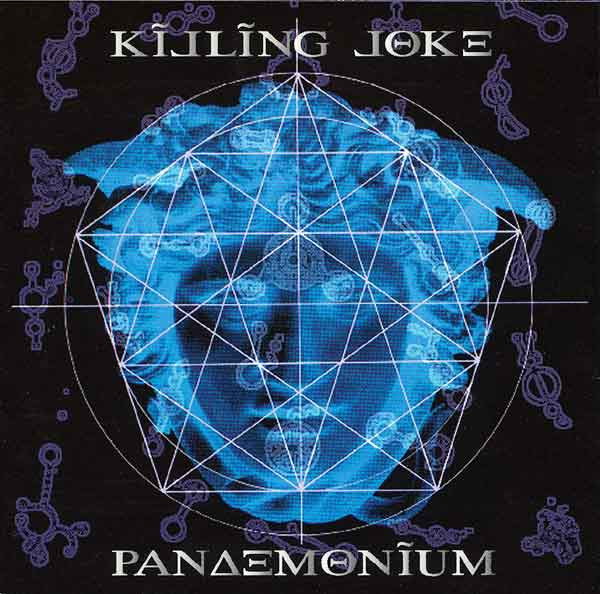
I have Killing Joke’s Pandemonium in my collection. I bought it because of “Millennium” — the single that reached the UK Top 40, their biggest hit alongside “Love Like Blood.” It’s a heavy, industrial-tinged record, produced by Youth (Martin Glover, the original Killing Joke bassist who came back after a decade away). Nothing about it sounds unusual from the outside. It’s a good record. It sold well.
But when you look at where the vocals were recorded, the story changes completely.
The Idea
In August 1993, Jaz Coleman and Youth flew to Cairo to record vocal tracks for the album. Their contact in Egypt was Mary Lomando, an Egyptology student who had previously recorded inside the Great Pyramid with producer Bob Clearmountain. She knew how to get in.
Youth wanted to record in the King’s Chamber of the Great Pyramid of Giza. Not a studio in Cairo. Not a converted church hall. The actual King’s Chamber — the granite room at the heart of the Great Pyramid, the oldest of the Seven Wonders of the Ancient World, built around 2560 BC.
Coleman thought he was “completely potty.” He’d been working in Egypt for years and knew how difficult it would be to organize anything like that. He couldn’t see that it would be even remotely possible.
Youth’s reasoning was esoteric. The pyramid sits on the 33rd parallel, which he believed was tied to earth-energy ley lines. The proportions of the King’s Chamber are based on the Golden Mean. He was attracted by what he called the “esoteric, occult significance.”
The Bribe
They met with the Minister for Antiquities. Coleman described him as “a fat, sweaty” man. The minister asked, “So you want the Great Pyramid for meditation purposes, yes? Yes?”
Youth took out three thousand pounds from his pocket, slapped it on the table, and a sweaty hand picked it up and shoved it in his pocket. “You now have the Great Pyramid for three days,” the minister said.
The deal was done. Complete bribery. Lomando later confirmed there were two rates: a lower one for private meditation, a higher one for commercial use. They paid the lower rate.
They stayed near the Sphinx with Khadija, an ex-Pan Am stewardess from Texas who had converted to Islam and ran a yoga retreat. Coleman described her as “a very sexy Texan lady” who wore skin-tight jeans and cowboy boots — unusual attire for Egypt. When men on site swarmed toward her, she pulled her T-shirt down and shouted, “Are you looking at my tits, Mohammed?” and started slapping them around the head until they ran off.
The First Night
They brought battery-powered recording equipment into the King’s Chamber and turned off the electricity. By candlelight, they set up to record.
It was a disaster. The batteries were draining almost immediately — what should have lasted eight to ten hours gave them only ten or fifteen minutes of power. Coleman broke down in tears on the floor. Youth thought it was the brandy. The takes they managed to get were sterile, unusable.
They went back to the hotel early.
The Ceremony
Youth meditated on the failure and decided the problem was ceremonial. Pyramids, he reasoned, were “all about threes.” So they needed three men — himself, Coleman, and one engineer — and three women in the chamber. Everyone else stayed in the Queen’s Chamber.
The second night, they came back with a completely different approach. Youth conducted the ceremony “virtually naked with just a very thin lungi round my waist,” running around with burning sage bushes. He’d brought flowers, garlands, incense, holy water, and naturally wand-shaped quartz crystals — which he believed could “cut through negative psychic binds.” He used them in “casting the circle.”
Coleman stood behind the granite sarcophagus. Youth and engineer Greg Hunter pointed the quartz wands at him while he sang. “We kind of screamed at Jaz,” Hunter said, “and he screamed back.”
Then the Egyptian recording engineer, Sameh Almazny, fell asleep during the ceremony. He woke up with a start and ran out of the pyramid, screaming. He later said: “It’s like a nightmare. These eyes, shiny eyes, come to my dreams many times. From this day, I never go to the pyramids.”
The Three Women
In the middle of the recording, three women who had been waiting in the antechamber suddenly walked into the King’s Chamber wearing full Egyptian ceremonial costumes. It was unexpected. Youth didn’t even recognize them. He turned to Coleman and said: “‘Ere, Jaz, who are those three weirdos at the back?”
The women included Khadija, who played the harp and sang with what Lomando described as “the most beautiful operatic voice.” The vibrations, Lomando believed, set up something in the chamber.
“That’s when the vibe got really weird,” Hunter said, “and we started to get some good takes.”
The Levitation
Coleman described the recording state as a kind of possession. “When I go into that state of grace I’m not conscious of anything else. You become it, you personify it. You become a vessel, a channel, a portal.”
Youth said there was a point when “it seemed like Jaz was levitating, floating in the air in the chamber.”
They got the vocals. Three tracks: “Exorcism,” “Pandemonium,” and “Millennium.”
The Aftermath
When they came out of the pyramid, there was what Coleman described as a “festival of Bedouin berbers” — about fifty musicians playing drums, people singing and dancing, welcoming them.
The album Pandemonium reached number 28 in the UK. It was Killing Joke’s best-selling record.
The session was filmed by director Shaun Pettigrew and appears in the Killing Joke documentary The Death and Resurrection Show. Coleman mentioned that Aleister Crowley had The Book of the Law dictated to him in the King’s Chamber — adding another layer of occult history to the location where they’d just recorded vocals for a post-punk industrial album.
I’ve owned this record for years. I never thought about where the vocals were recorded. I just heard a heavy, well-produced album. But the story behind those three tracks — the bribe, the drained batteries, the naked bassist with burning sage, the engineer who ran out screaming, the women in ceremonial costume, the possible levitation — is one of the strangest things I’ve ever found hiding in my own collection.
You think you know a record. Then you pull it off the shelf and discover it was recorded in a 4,500-year-old tomb by candlelight, powered by quartz crystals, after a cash transaction with a sweaty government minister.
Album: Pandemonium — Killing Joke (1994, Butterfly Records/Zoo)
Sources: Louder Sound, “What happened when Killing Joke recorded inside the Great Pyramid at Giza” (Johnny Black, February 2020); Wikipedia, “Pandemonium (Killing Joke album)”; NZ Herald, “Jaz Coleman’s madness and passion” (Scott Kara, June 2013); Revolver Magazine, “Killing Joke: The Weird, Wild Story of Revered Cult Industrial Pioneers” (Kory Grow, January 2013).