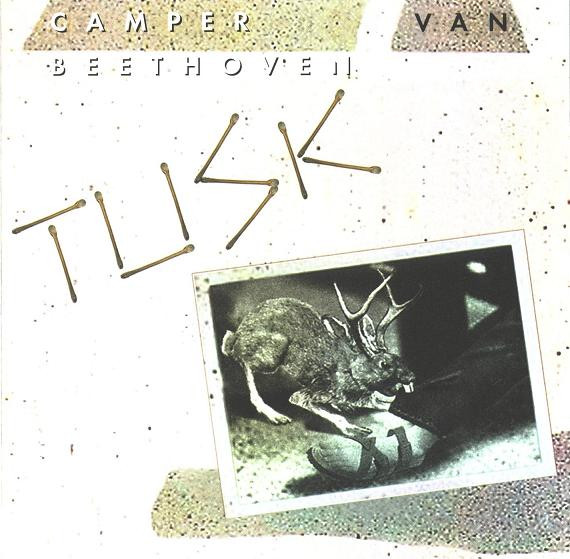
I own Camper Van Beethoven’s Tusk. I bought it because I thought the concept was funny — an indie band from Santa Cruz covering Fleetwood Mac’s entire double album, song for song. A novelty. A joke between friends.
But when I started digging into the original, I found something I never expected: the most expensive rock album ever made was secretly a punk record. And the indie band that covered it understood that better than anyone.
Here’s what I thought I knew about Fleetwood Mac’s Tusk: it was the follow-up to Rumours, it sold a lot of copies, and it had that one song with the marching band. That’s most people’s understanding. A big, expensive, slightly disappointing sequel.
But the real story is so much stranger.
After Rumours sold ten million copies, Warner Bros. wanted Rumours 2. Lindsey Buckingham wanted to burn it all down. He was listening to Talking Heads. He was listening to post-punk. He decided that the next Fleetwood Mac album should sound nothing like Fleetwood Mac. “I intended for Tusk to subvert the expectations of creating a Rumours 2 and Rumours 3, which is kind of the business model Warner Bros. would have liked us to follow,” he said.
So Buckingham went into the studio and started doing things no one in a soft-rock band had any business doing. For certain songs, he played a Kleenex box as a snare drum. Mick Fleetwood, trying to get a percussive slap sound, bought a leg of lamb from a butcher and hit it with a spatula. (The overdub was ultimately unused, but they recorded it.) An audio engineer named Hernán Rojas recorded Chilean profanities — including “puta la cagó” — and those ended up in the final mix. They ran a fifteen-second tape loop of two-inch magnetic tape across the room on microphone stands, let it cycle for ten minutes, and built the title track over it.
And then there was the marching band.
Mick Fleetwood had been woken up by a brass band playing in the streets of Barfleur, a village in Normandy. He went outside with a bottle of Beaujolais and joined the dancing. “That joyous, irresistible cacophony is what I heard when I listened to that loop of the riff,” he said. So he called the University of Southern California and asked for their Trojan Marching Band. All 112 of them. He recorded them at Dodger Stadium, with a mobile studio, while the band members marched in place for timekeeping purposes. A Dodgers player named Ron Cey — who had been sitting in on Fleetwood Mac sessions — got them the stadium for free.
The whole thing cost $1.4 million. In 1979. That was the most expensive rock album ever made. Adjusted for inflation, it’s over $6 million today.
Warner Bros. considered it a commercial failure. It sold four million copies. Four million. That’s a failure.
So in 2001, an indie band from Santa Cruz decided to cover the whole thing. Every song, both discs, song for song. Not as a tribute. Not as a joke. As a test.
Camper Van Beethoven had broken up in 1990. David Lowery had gone on to form Cracker, which had its own success. The other members had scattered. By the early 2000s, little pieces of the band were working together again — Lowery and Jonathan Segel were doing sessions, Victor Krummenacher was playing with various projects. They needed something to prove they could still function as a unit. So they picked the most extravagant, overstuffed, cocaine-fueled double album in rock history and said: let’s play every note of this.
They recorded it in 2001 and released it in 2002 on their own label, Pitch A Tent. At first, they claimed it was a lost recording from the late ’80s — a fake origin story that fit the conspiracy-theory energy of the project. “A joke within a joke,” Lowery called it. They had to pretend it was old because Lowery was still under contract to Virgin Records for Cracker.
The bass player, Victor Krummenacher, described the original Tusk as “like the Magnificent Ambersons of rock, a work that’s supposed to be good, but is really just a cocaine-damaged horror of excess. Which is why we took it on, I suppose, and I think we improved upon it.”
A critic at the New York Press put it even more bluntly: “The strange thing about you guys doing Tusk — the Fleetwood Mac album — is that Fleetwood Mac exploded in this fireball of flame and wife-swapping, animosity and all that stuff, whereas you guys disintegrated like a urinal cake.”
And here’s the part that got me: Lindsey Buckingham heard it. And he loved it.
“They took some of the songs to such different places,” Buckingham said. “I thought, ‘Wow, where did they come up with that?’ Just the fact that a group of guys would sit around and want to remake a whole album like that. That was just a trip, I have to say. I loved it.”
Think about that for a second. The guy who spent $1.4 million making the most extravagant album in rock history heard a bunch of indie musicians strip it down, warp it, and rebuild it — and his response wasn’t indignation. It was delight. Because Buckingham knew what Tusk actually was. It wasn’t a sequel to Rumours. It was an act of creative destruction disguised as a double album. It was the sound of a band trying to tear down the thing that made them famous, using whatever was at hand — a Kleenex box, a leg of lamb, 112 marching band members, Chilean profanity.
And Camper Van Beethoven heard that. They heard the punk record hiding inside the most expensive album ever made. They covered it not because they loved Fleetwood Mac, but because they loved what Fleetwood Mac was trying to do — destroy their own expectations, using whatever was at hand.
I bought Tusk as a joke. I kept it because it’s one of the most honest things in my collection — a record about what happens when a band decides the only way forward is to burn down everything that got them there.