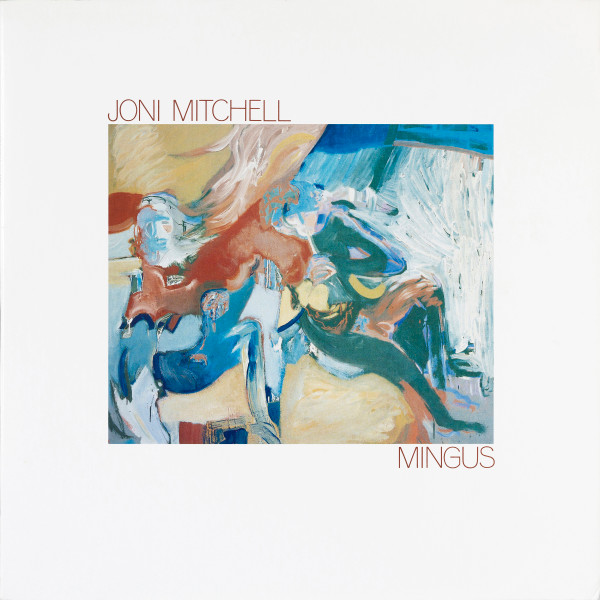
I’ve had Joni Mitchell’s Mingus for years. It’s the album where she collaborates with one of the greatest jazz composers in history, backed by Jaco Pastorius, Wayne Shorter, and Herbie Hancock. I listened to it without knowing the story behind it. The story changes everything.
Charles Mingus was dying. He’d been diagnosed with ALS — Lou Gehrig’s disease — in 1976. By 1978, the disease had left the big, combative man paralyzed. He couldn’t play bass. He couldn’t compose in any conventional sense. But the music didn’t stop filling his head. He needed someone to make it real.
He needed a collaborator. And he chose a white woman from the rock world.
The Blackface Cover That Started It
The thing that caught Mingus’s attention was Joni Mitchell’s album cover for Don Juan’s Reckless Daughter. On it, she appeared in darkface — an alter ego character she’d invented. Mingus, who had railed against racism in his autobiography Beneath The Underdog, was initially offended. But he also recognized something: this woman had “a lot of balls.” She was willing to do things that made people uncomfortable.
Mingus’s management begged him not to do it. “You’ll just plummet into obscurity,” they told Joni. She ignored them.
In April 1978, Mingus called Joni to say he’d written six songs. He called them “Joni I” through “Joni VI.” They were waiting for her lyrics and voice.
The Hospital Sessions
Mingus was in a wheelchair by then. He couldn’t hold a bass. But he could still hear what he wanted, and he could still argue about it.
When Joni brought him her lyrics, Mingus told her she was singing the wrong note. She said the word needed to go up, not down — it needed optimism, not resignation. “But that’s a square note,” he said. So Joni told him: “You know, Charles, that note’s been square so long it’s hip again.”
He said: “OK, motherf**ker, you put in your note and my note and two grace notes too.”
This was a man who could barely move, arguing about grace notes. He was 56 years old and would be dead in months.
The Band She Assembled
Joni recorded the album at A&M Studios in Hollywood with a band that reads like a roll call of jazz royalty. Jaco Pastorius on fretless bass — the same Jaco who had played on Hejira and Don Juan’s Reckless Daughter, the bassist who was quietly becoming the most exciting musician in jazz. Wayne Shorter on soprano saxophone, the former Weather Report co-leader. Herbie Hancock on electric piano. Peter Erskine on drums. Don Alias on percussion.
Before settling on this lineup, Joni had tried out the material in New York with an even more astonishing crew: Gerry Mulligan, John McLaughlin, Stanley Clarke, Eddie Gomez, Tony Williams. Those “experimental sessions” were scrapped.
There were five spoken-word tracks scattered across the album — “raps” — captured from informal recordings of Mingus talking. “I’m not rich but, y’know, I’ve always had a few, some dollars in my pockets.” They’re the last surviving fragments of his voice on record.
The Day He Died
Charles Mingus died in Cuernavaca, Mexico on January 5, 1979. He was cremated the next day.
Joni wrote in the liner notes: “Charles Mingus, a musical mystic, died in Mexico, January 5, 1979, at the age of 56. He was cremated the next day. That same day 56 sperm whales beached themselves on the Mexican coastline and were removed by fire. These are the coincidences that thrill my imagination.”
Fifty-six years old. Fifty-six whales. Removed by fire, like him.
His wife Sue carried his ashes to India. At the source of the Ganges, where the river ran turquoise and glinted with large gold carp, she released them with flowers and prayers at the break of a new day.
The Album Nobody Wanted
Mingus came out June 13, 1979 — five months after his death. It peaked at number 17 in the US. Critics were divided. DownBeat gave it five stars. Robert Christgau gave it a C+. Pitchfork, decades later, would call it “a failed experiment.”
The album Joni made in the wake of a dying man’s last compositions — with a rhythm section considered among the finest in jazz — was treated as a curiosity. A folk singer playing dress-up in jazz clothes. Except she wasn’t playing. She was doing what Mingus had asked her to do: singing his music in her voice.
The last track is “Goodbye Pork Pie Hat” — Mingus’s elegy for Lester Young, the tenor saxophone player who changed everything. Joni wrote lyrics for it. It closes the album with a goodbye inside a goodbye.
I’ve had this album for years. I never knew any of this. That a man who couldn’t move his hands wrote six songs with Joni Mitchell’s name in their titles, and that he chose her to finish what he could no longer do. That the songs were a dying man’s last will. That the album came out five months after he was gone. That the liner notes carry a goodbye inside a goodbye.
Album: Mingus — Joni Mitchell (1979, Asylum Records) Key credits: Charles Mingus (composer, spoken word), Jaco Pastorius (bass), Wayne Shorter (soprano saxophone), Herbie Hancock (electric piano), Peter Erskine (drums), Don Alias (percussion) Sources: Discogs — Mingus credits Wikipedia — Mingus (Joni Mitchell album) Grammy — Joni Mitchell’s ‘Mingus’ At 40 CharlesMingus.com — Remembering Charles Mingus