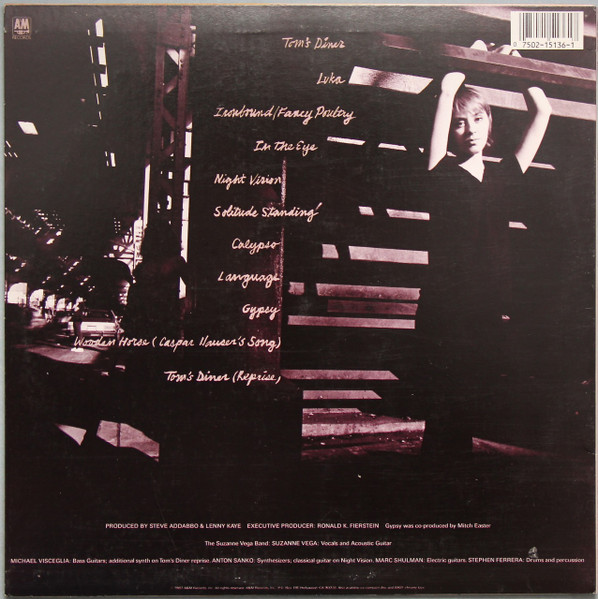
I have Suzanne Vega’s Solitude Standing on CD. I’ve had it for years. The first thing you hear when you put it in is an a cappella voice — no instruments, no beat, just a woman singing about getting coffee at a restaurant on Broadway and 112th Street in Manhattan. The song is two minutes and nine seconds long. It’s called “Tom’s Diner.”
I always assumed it was a minor track. A charming opener. A palate cleanser before “Luka” and the rest of the album. It turns out that this two-minute acapella folk song is the reason your MP3s sound the way they do.
The story starts in 1981 or early 1982, when Vega was a student at Barnard College and a regular at Tom’s Restaurant, the real diner on the corner of Broadway and West 112th Street. A photographer friend named Brian Rose had told her that sometimes he felt like he was watching his life “through a pane of glass” — present but never quite involved. She sat in the diner and tried to write from that perspective. The song came out as a stream of consciousness: coffee, two women, church bells, a midnight picnic. She wrote it down on a napkin.
A few years later, a German electrical engineer named Karlheinz Brandenburg was finishing his PhD thesis at the University of Erlangen. His advisor, Dieter Seitzer, had a vision for a “digital jukebox” — music streamed on demand over ISDN phone lines. But ISDN bandwidth was way too narrow for CD-quality audio. A CD delivers about 1.4 million bits per second of stereo audio. ISDN could handle roughly a tenth of that. Seitzer needed compression at a ratio of 12-to-1. He’d applied for a patent on the concept, and the patent office had rejected it as “impossible.”
Brandenburg was assigned to prove them wrong. He worked on a compression scheme that exploited the limits of human hearing — throwing away data the ear can’t actually perceive. He was deep in the math when he found a review in a hi-fi magazine. The magazine had been testing loudspeakers, and they’d used “Tom’s Diner” as one of their test tracks. Brandenburg’s reaction, as he later told Swedish television: “OK, let’s test what this song does to my sound system, to MP3.”
The result was a disaster. At bit rates where everything else sounded fine, Vega’s voice sounded horrible. The acapella vocal — just one human voice, no instrumentation to hide behind — was a torture test for compression. Every artifact, every frequency the algorithm decided to discard, showed up naked against her voice. Brandenburg kept refining his algorithm, listening to “Tom’s Diner” again and again, making sure it survived. He later recalled: “I was ready to fine-tune my compression algorithm…somewhere down the corridor, a radio was playing ‘Tom’s Diner.’ I was electrified. I knew it would be nearly impossible to compress this warm a cappella voice.”
The format Brandenburg was building became MPEG-1 Audio Layer III — better known as MP3. When it shipped in 1993, nobody noticed. When Napster launched in 1999 and MP3 became the format of the file-sharing revolution, Brandenburg’s name still wasn’t on most people’s lips. But every song that passed through that codec — every Napster download, every iPod track, every Spotify stream that relies on perceptual compression derived from the same principles — was refined against Vega’s voice first.
Here’s what I find strange about this. Vega wrote the song about feeling detached from life, about watching the world through glass. It was a personal exercise, a tiny literary experiment written on a napkin. And then that song — the song about watching — became the filter through which billions of people would hear music for the first time. She became, as the music press later dubbed her, “the Mother of the MP3.”
And then there’s the restaurant. Tom’s Restaurant, the diner in the song, later became famous as the exterior of Monk’s Café in Seinfeld. The building on Broadway and 112th is now visited by tourists who know it from a TV show about nothing. Vega knew it first, as a student eating breakfast and writing about a rainy morning. The song she wrote there became more famous as a DNA dance remix in 1990 — a beat grafted onto her vocals without her permission, which her label chose to release rather than sue over, and which reached number five on the US charts. She’d originally conceived it as voice and piano. The world preferred it with a beat and then, later, preferred it compressed into a format that strips away the data your ears can’t hear.
There are over 50 known versions of the song now. A sound artist named Ryan Maguire released a track in 2015 called “moDernisT” — an anagram of “Tom’s Diner” — composed entirely of the sounds that MP3 compression deleted from the original recording. The ghost in the MP3. The data your ears supposedly couldn’t hear, extracted and played back on its own.
I own Solitude Standing. I’ve listened to it dozens of times. I always thought “Tom’s Diner” was a pleasant little song about a coffee shop. I had no idea that a German engineer in Erlangen, Germany spent years listening to it — not because he was a fan, but because if he could make her voice survive compression, he could make anything survive compression. That the format that changed how the world listens to music was stress-tested against a Barnard College student’s napkin sketch about watching life through glass.
That’s the thing about records in your collection. Sometimes the track you skip to get to the hits is the one that shaped everything.