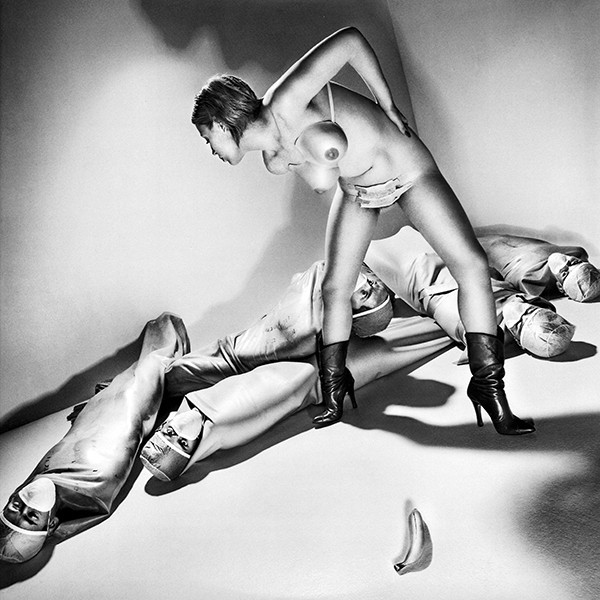
I’ve owned Devo’s Q: Are We Not Men? A: We Are Devo! for years. I’ve listened to “Jocko Homo” and “Mongoloid” and “Uncontrollable Urge” dozens of times. I knew the band was from Akron. I knew Mark Mothersbaugh went on to score Rugrats and four Wes Anderson films. I knew the band’s concept was “de-evolution” — the idea that humanity was regressing rather than progressing.
I never looked into where that idea came from.
It came from a massacre.
May 4, 1970
On May 4, 1970, members of the Ohio National Guard opened fire on students protesting the Vietnam War’s expansion into Cambodia at Kent State University in Kent, Ohio. Four students were killed. Nine were wounded. The campus was sealed off with crime-scene tape and placed under martial law for six weeks.
Two of the future members of Devo were art students at Kent State at the time. Jerry Casale was a senior. Mark Mothersbaugh was also there, studying art.
Casale was standing in a group looking up a hill at the Guard members when they fired. The shots went over his head. He knew two of the four students who were killed — Jeffrey Miller and Allison Krause, both freshmen — through his campus job as a counselor for incoming students.
“That day changed me fundamentally,” Casale told an interviewer. “I think I had a nervous breakdown that day, although nobody talked about that then.”
He later said, with no ambiguity: “Devo and the idea of De-evolution as a manifesto would not exist without that defining historic trauma I experienced.”
The Third Student
Here’s the part I didn’t know.
Chrissie Hynde — the future frontwoman of The Pretenders — was also at Kent State. She was eighteen years old, an art student, and she was there on May 4, 1970.
“I was there, I heard the shots,” she told The Guardian years later. “I was right in the middle of it, and I knew one of the guys that got killed.”
Three future music icons. One campus. One afternoon. The same gunshots.
Casale and Mothersbaugh channeled what they witnessed into Devo — a band built on the idea that something had gone terribly wrong with human civilization, that we were coming apart rather than coming together. Their music was angular, jerky, mechanical. It sounded like machines malfunctioning. It was art as confrontation. “It was a conceptual gun to the head,” Casale said of the early work.
Hynde went a different direction. Three years after the shooting, she moved to London and never came back. She formed The Pretenders in 1978. Her music was tough, melodic, emotionally direct — everything Devo wasn’t. But she carried the same experience. “Was it a defining moment for me?” she said. “Well, I already knew I wanted to move on.”
What Devo Became
The early recordings — the ones on the Hardcore Devo collections, made on four-track machines in Akron between 1974 and 1977 — sound like urgency compressed into tape hiss. “Mechanical Man,” “Auto Modown,” “Social Fools.” These weren’t pop songs. They were dispatches from people who’d seen something they couldn’t unsee.
By the time Q: Are We Not Men? A: We Are Devo! came out in 1978, produced by Brian Eno, the band had sharpened the rawness into something stranger and more precise. “Jocko Homo” still carried the question — “Are we not men? Are we devo?” — but now it was wrapped in synth pulses and robotic rhythms. The de-evolution concept had become a joke, a manifesto, and a pop hook, all at the same time.
And then Mothersbaugh — the same person who stood on that Kent State hillside in 1970 — went on to compose the music for thirteen years of Rugrats. He scored Bottle Rocket, Rushmore, The Royal Tenenbaums, and The Life Aquatic with Steve Zissou. He wrote the music for Thor: Ragnarok. The kid cartoons. The Wes Anderson whimsy. The Marvel superhero movie.
The same hands that built Devo’s mechanical de-evolution built the soundtrack to children growing up.
The Distance
I keep coming back to the distance between these things. The same campus. The same afternoon. Three people who walked out of the same event and ended up in completely different places — a synth-punk band that questioned whether humans were worth saving, a rock band that made some of the best singles of the 1980s, and a film composer who scored the movies we watch on Sunday afternoons.
Casale called the shooting a “politicized Rite of Spring.” That’s the right phrase. Something broke open that day, and what came out of it was art — angular, furious, funny, beautiful, depending on which student you followed.
I own records by all three of them. I’ve listened to them for years. I never knew they were standing in the same place when everything changed.