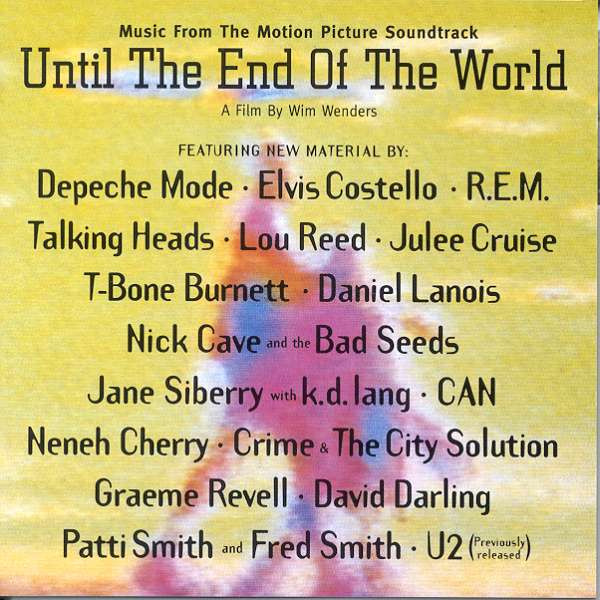
Until the End of the World: Music from the Motion Picture Soundtrack (1991)
There’s a soundtrack in my collection that I bought because I’m a completist about certain things. Until the End of the World — a 1991 Wim Wenders film about a man chasing a device that can record dreams. The movie is long and strange and not for everyone. But the soundtrack is something else entirely.
I put it on the shelf next to the other soundtracks and didn’t think much about it. Then last week I actually looked at the tracklist.
Track 2: Talking Heads — “Sax And Violins”
Track 6: Lou Reed — “What’s Good”
Track 7: Can — “Last Night Sleep”
Track 8: R.E.M. — “Fretless”
Track 9: Elvis Costello & Ray Davies — “Days”
Track 11: Nick Cave & The Bad Seeds — “(I’ll Love You) Till The End Of The World”
Track 12: Patti Smith — “It Takes Time”
Track 13: Depeche Mode (Martin L. Gore) — “Death’s Door”
Track 15: k.d. lang & Jane Siberry — “Calling All Angels”
Track 17: Daniel Lanois — “Sleeping In The Devil’s Bed”
Track 18: U2 & Brian Eno — “Until The End Of The World”
All on one record. All written for the same movie. And almost every one of these artists is already in my collection.
How This Happened
Wim Wenders had a concept for his film: in the year 1999, a device has been invented that can record people’s dreams and play them back. The characters in the film travel around the world — Berlin, Lisbon, the Australian outback, the California coast — and everywhere they go, they encounter music.
Wenders didn’t want to score the film in the traditional sense. He wanted to ask specific artists to write songs that would exist in the world of the film — music that the characters might actually hear. He approached each artist individually and asked them to compose something original.
The result is a collection of songs that could never exist on any other record. Can — a German experimental band — hadn’t recorded together in years, but they came back for this. Elvis Costello and Ray Davies of The Kinks sat down and wrote a song together. Daniel Lanois, better known as a producer, stepped in front of the microphone. Brian Eno and U2 contributed a different version of their Achtung Baby track.
Every song on this soundtrack was created specifically for the film. Most of them never appeared on the artists’ own albums.
The Elvis Costello Connection
The track that caught my eye is “Days” — credited to Elvis Costello & Ray Davies.
I have fifty-two Elvis Costello albums. I have forty Kinks albums. I’ve listened to both of them for decades. I never knew they’d written a song together.
Davies and Costello are kindred spirits — both British, both wordy, both obsessed with the characters and stories hiding in ordinary life. But they’d never formally collaborated before this. Wenders asked Costello to write a song for the film, and Costello reached out to Davies.
The result is a quiet, melancholy song about time passing — fitting for a film about dreams and memory. It’s not a Kinks song and it’s not an Elvis Costello song. It’s something that only exists because a German filmmaker asked two of England’s best songwriters to work together.
The Can Reunion
Track 7 is “Last Night Sleep” by Can. The credits list Irmin Schmidt, Jaki Liebezeit, Malcolm Mooney, and Michael Karoli — four of the five members of Can.
Can had been dormant since the early 1980s. Holger Czukay, the band’s bassist and a musician known for his work with Can and for unusual approaches to sound, had been making solo records and collaborating with other artists — including David Sylvian, whose Brilliant Trees (1984) features Czukay on French horn and guitar. Czukay’s solo work was already in the orbit of the kind of music Wenders was collecting for this soundtrack.
But Can as a band hadn’t played together. Wenders asked, and they came back. It’s one of the few times the original Can lineup recorded together after their dissolution.
Daniel Lanois Steps Out
Track 17 is “Sleeping In The Devil’s Bed” by Daniel Lanois. Lanois produced U2’s The Joshua Tree, Bob Dylan’s Oh Mercy, Peter Gabriel’s So, and Emmylou Harris’s Wrecking Ball — records that are all in my collection. He usually stays behind the glass.
For this soundtrack, he stepped in front of the microphone. The song is a slow, atmospheric piece that sounds like the landscape of the film — wide open spaces, long horizons, the kind of music that makes you think of driving at dusk.
Lanois also produced Brian Eno’s contributions to the same soundtrack. The line between producer and artist blurred on this record in ways it rarely does elsewhere.
The Connections
Here’s what I didn’t realize until I started pulling the threads:
Daniel Lanois produced U2’s The Joshua Tree. Brian Eno co-produced it. Both appear on this soundtrack. U2 appears on it too.
The soundtrack reads like a map of my record collection. Every track leads to another shelf.
What I Didn’t Know
I’ve owned this soundtrack for years. I bought it because I like soundtracks, and because I recognized some of the names. I never once looked at the full tracklist and noticed that Can, Talking Heads, R.E.M., Elvis Costello, Lou Reed, Nick Cave, Patti Smith, and Daniel Lanois were all on the same record.
I never realized that Elvis Costello and Ray Davies had written a song together.
I never realized that Can had reunited — even briefly — for a German film director’s dream project.
The record was sitting on my shelf the whole time, waiting for me to actually look at it.
Album: Until the End of the World: Music from the Motion Picture Soundtrack (1991, Warner Bros. Records) Key artists: Talking Heads, Can, Lou Reed, R.E.M., Elvis Costello & Ray Davies, Nick Cave & The Bad Seeds, Patti Smith, Depeche Mode, k.d. lang & Jane Siberry, Daniel Lanois, U2 & Brian Eno
Sources: Discogs — Until the End of the World soundtrack credits Wikipedia — Until the End of the World (soundtrack)