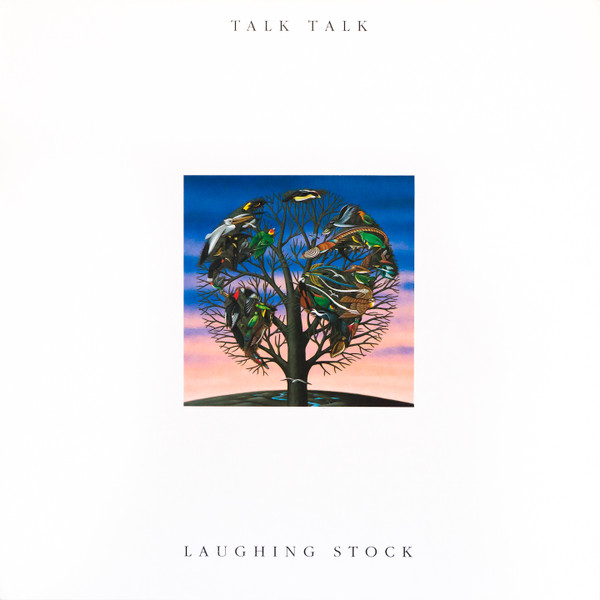
Laughing Stock (1991) — Talk Talk
There’s a building at 106a Highbury New Park in Islington, London. It was built in 1881 as the church hall of St Augustine’s Church, a Gothic Revival structure with vaulted ceilings and thick stone walls. From 1946 to 1949, it was the home of the Rank Organisation’s Company of Youth — the “Rank Charm School” — where future British film stars like Diana Dors and Christopher Lee were tutored.
By the mid-1960s, a recording engineer named Mike Thompson converted it into a studio. He installed a custom 24-channel Neve console — London’s first 24-track desk — and called it Wessex Sound Studios.
What happened inside that converted church hall over the next three decades is one of the strangest stories in recording history. And two of the albums made there are in my collection.
The Sex Pistols and Queen, Simultaneously
In October 1976, the Sex Pistols walked into Wessex to record their debut single, “Anarchy in the U.K.” They came back the following year to record Never Mind the Bollocks, Here’s the Sex Pistols — the only studio album they’d ever make.
At the same time, in an adjacent studio, Queen was recording material for News of the World.
The two bands were there at the same time. And according to Wessex engineer Bill Price, the encounters were exactly as awkward as you’d imagine.
Sid Vicious stumbled into Queen’s studio and asked Freddie Mercury, “Have you succeeded in bringing ballet to the masses yet?” — a reference to a comment Mercury had made in an NME interview. Mercury reportedly called him “Simon Ferocious” (Vicious’s real name) and replied, “We’re doing our best, dear.”
Johnny Rotten, meanwhile, crawled on all fours across Queen’s studio to Mercury, who was sitting at a piano. He said “Hello Freddie” and then crawled back out.
Brian May later recalled bumping into Rotten in the corridors and having several conversations about music.
This happened in the same room where, fourteen years later, Mark Hollis would sit in total darkness with candles and oil-wheel projectors, recording the album that would become Spirit of Eden.
How Talk Talk Ended Up at Wessex
Talk Talk had been a synth-pop band. “It’s My Life” (1984) and “Such a Shame” (1984) were massive European hits — bright, radio-friendly new wave with catchy hooks. The band was on EMI, and the label expected more of the same.
Then something shifted. The Colour of Spring (1986) sold over two million copies, but it was a different kind of record — more organic, more textured, built around improvised performances from sixteen musicians. It was their most successful album, and it gave them the leverage to do whatever they wanted next.
What they wanted was Spirit of Eden.
EMI gave them an open budget and complete control. Their manager and label executives were barred from the studio sessions. The band — now reduced to Mark Hollis and drummer Lee Harris after bassist Paul Webb left — set up at Wessex Sound Studios and began recording in May 1987.
The process was extraordinary. The studio was blacked out. Oil projectors cast slow-moving patterns on the walls. Strobes flickered. Sometimes it was total darkness. Musicians were led into the studio blind, given headphones, and asked to play. They couldn’t see each other. They couldn’t see the control room. They improvised for hours, and then Hollis and producer Tim Friese-Greene would spend months editing and arranging the results.
Engineer Phill Brown, who had worked on the sessions, described it: “Twelve hours a day in the dark listening to the same six songs for eight months became pretty intense. There was very little communication with musicians who came in to play. They were led to a studio in darkness and a track would be played down the headphones.”
The recording took ten months. Hollis didn’t write the lyrics until seven or eight months into the process. The vocals were among the last things committed to tape.
Spirit of Eden was released in September 1988. EMI had their doubts about it long before it was finished — they’d asked Hollis to re-record songs or replace material, and he’d refused. The album sold poorly. The label dropped Talk Talk.
Laughing Stock
The band signed to Polydor, who released their next album on the Verve Records label — a jazz imprint. They had no bassist. It was just Hollis and Harris, plus whoever they could bring into the studio.
They went back to Wessex. They went back to the darkness.
Laughing Stock was recorded between September 1990 and April 1991, again with Phill Brown engineering and Tim Friese-Greene producing. The same approach: improvised sessions, recorded by chance and accident, then edited down over months into six tracks that sound like they were always meant to exist.
The album sold poorly. The band split up shortly after its release. Mark Hollis made one solo album in 1998 — also engineered by Phill Brown — and then disappeared from music entirely. He gave no interviews, made no public appearances, and offered no explanation. He died in 2019.
Laughing Stock was initially overlooked. Then Pitchfork gave it a perfect 10 out of 10 and named it the eleventh best album of the 1990s. Stylus Magazine named it the greatest post-rock album.
The Same Room
I’ve had Laughing Stock in my collection for a long time. I also have Spirit of Eden, and I have the Sex Pistols’ Never Mind the Bollocks. I bought them at different times, from different stores, in different moods. I never once thought about the fact that they were all made in the same room.
A converted Victorian church hall in North London. Built in 1881. Gothic arches, thick walls. Sid Vicious crawling across the floor while Freddie Mercury played piano. Eleven years later, Mark Hollis sitting in the dark, listening to the same six songs for eight months, waiting for the lyrics to arrive.
The building was sold in 2003 and converted into eight apartments and a townhouse. They called the development “The Recording Studio.”
The music is gone. The room is someone’s living room now. But the records are still there — three albums from the same space, three radically different visions of what music could be, all made within a few meters of each other across a span of fifteen years.
That’s what I think about when I put Laughing Stock on now. Not just the music, but the room. The darkness. The candles. And somewhere in the building, the ghost of Sid Vicious asking Freddie Mercury about ballet.
Album: Laughing Stock — Talk Talk (1991, Verve Records) Also referenced: Spirit of Eden — Talk Talk (1988, Parlophone/EMI); Never Mind the Bollocks, Here’s the Sex Pistols (1977, Virgin Records)
Sources: Wikipedia — Wessex Sound Studios Wikipedia — Spirit of Eden Wikipedia — Laughing Stock Discogs — Laughing Stock credits Discogs — Spirit of Eden credits