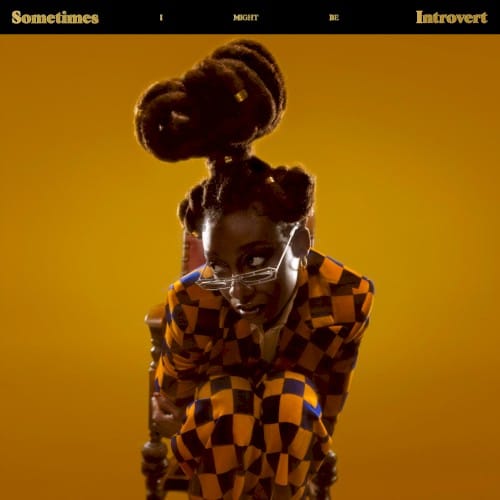
A British rap album that trades in beats for a full orchestra and somehow still hits harder than anything on the radio. Little Simz turns self-doubt into symphonic ambition, with Inflo’s production giving her rhymes the weight of a film score. Essential listening for anyone who thinks hip-hop has nothing new to say.
The first time you hear the strings drop into “Introvert,” you might check the speakers to make sure you haven’t wandered into a concert hall. That’s the point. Little Simz – born Simbiatu Ajikawo, raised in North London – didn’t just make another rap album. She made a film without the picture, a stage musical without the stage. Sometimes I Might Be Introvert is the kind of record that makes you re-evaluate what the genre can hold.
The title is a play on her own initials – SIMBI – and the album is structured as a concept piece about duality: the public self versus the private one, the extrovert performer and the introvert thinker. It’s a theme that could easily curdle into therapy-speak, but Simz is too sharp for that. She writes like someone who takes the craft seriously, stacking internal rhymes over strings that swell and retreat like breath.
A lot of the credit goes to Inflo – Dean Josiah Cover, the producer behind SAULT and Cleo Sol. He built the album around the London Symphony Orchestra, recorded at The Church Studios and RAK in London. The sessions weren’t cheap, and you can hear it. “Woman” arrives with a gospel choir and a Cleo Sol feature that turns a celebration into a benediction. “I Love You, I Hate You” pairs a whispered verse with a string arrangement that sounds like a memory collapsing in real time. These are not loops. These are compositions.
Simz raps in a dry, precise tone that cuts through the orchestral weight. She doesn’t belt or bark. She lets the words sit. On “Standing Ovation” she outlines the grind of the independent rapper with the same detail she brings to family portraits on “Little Q, Pt. 2.” It’s the specificity that makes it land – the way she describes her mum’s pride in one bar and her own exhaustion in the next.
This is an album that demands volume. The low end on “Point and Kill” – written with Jamaican dancehall producer Jae5 – is a bass note that rattles windows. The orchestral hits on “Gems” need air to breathe. Play it on laptop speakers and you’re missing the architecture. Inflo mixed it with stereo width and dynamic range that rewards a proper system. You want the strings to decay naturally, the kick to push into your chest.
If there’s a flaw, it’s that the album is almost too dense. At fifteen tracks and over an hour, it asks patience. A track like “The Rapper That Came to Tea” is a short skit that could have been cut without losing anything. But that’s a minor complaint. Simz is building a world, and worlds have corridors.
The best moment comes near the end. “How Did You Get Here” is a quiet piano piece where Simz reflects on imposter syndrome with the fatigue of someone who has achieved everything and still feels like she’s faking it. The strings drop out. The beat fades. It’s just her voice and a keyboard, and it’s more devastating than any crescendo.
Simz doesn’t resolve the tension. She lives in it, and she invites you to do the same.