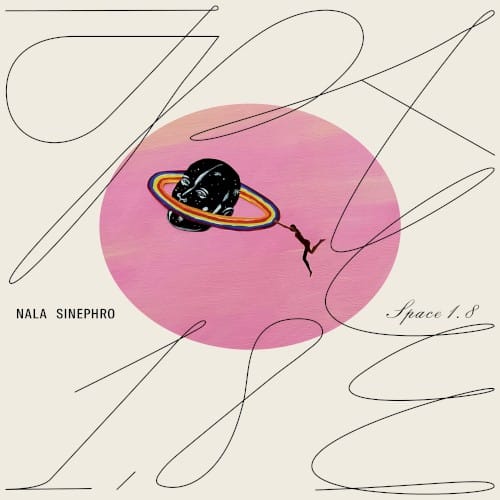
Nala Sinephro’s debut is a cosmic jazz suite built from harp, modular synth, and saxophone — eight movements that feel less like songs and more like weather patterns. It demands the kind of listening you usually reserve for last light.
There is a moment about four minutes into “Space 1” where the harp touches down and the modular synth starts to breathe like a living membrane. It’s not a solo; it’s an ecosystem. Nala Sinephro lets that pulse carry the track for nearly two minutes before the saxophone appears — James Mollison’s tenor, more vapor than note, hovering just above the mix.
That patience is the album’s signature.
Space 1.8, released on Warp Records in 2021, was recorded entirely in Sinephro’s home studio in south London. She produced and engineered it herself, which explains the intimacy. There is no producer’s hand smoothing the edges. The modular patches were designed to respond to the harp’s natural harmonics, and you can hear that feedback loop — an acoustic string pluck triggering a synth decay that then bleeds back into the room tone. It was all done without a click track, the tempos drifting as the microphones absorbed the air.
The personnel is small but vital. Mollison’s saxophone appears on most of the eight movements, his lines improvised in single takes. Rudi Linschoten’s drums are more texture than backbeat — cymbals turned to silver dust. Twm Dylan’s double bass walks a slow, deep line underneath, and the AAYA Collective string quartet adds a chamber gravity when the electronics open up. But Sinephro herself is the anchor, cycling between harp, Rhodes, and a Eurorack system that sounds like it is thinking.
This isn’t background music. It demands the same attention you’d give a thunderstorm.
The album’s eight “Space” tracks form a single arc, but each has a distinct emotional center. “Space 5” is the closest to a conventional jazz tune, with a clear head melody shared between harp and sax, while “Space 7” dissolves into pure harmonic drone. The modular synth is never flashy — Sinephro uses it to create a sense of place, not to show off. She told an interviewer she wanted the album to sound “like looking at a star that’s already dead.”
On a good system, you can feel the low frequencies move like a tide. On headphones, the stereo imaging is ludicrously precise — Mollison’s sax will drift from the left channel into a reverb that opens behind your ears. The harp, recorded close, has a physical attack that cuts through the synth wash. It is the kind of album that rewards volume, because the quieter moments — the tape hiss between movements, the sound of a pedal releasing — become part of the listening.
Brian Eno once said that ambient music must be “as ignorable as it is interesting.” Sinephro’s album tips heavily toward the interesting. It is a debut that could only come from someone classically trained but deeply immersed in the modular world, someone who trusts the audience to sit with a chord change for two minutes while a filter slowly opens.
Play it at night, loud enough to feel the low frequencies in your chest. And next time someone asks what spiritual jazz sounds like in 2021, put on “Space 1” and leave the room.