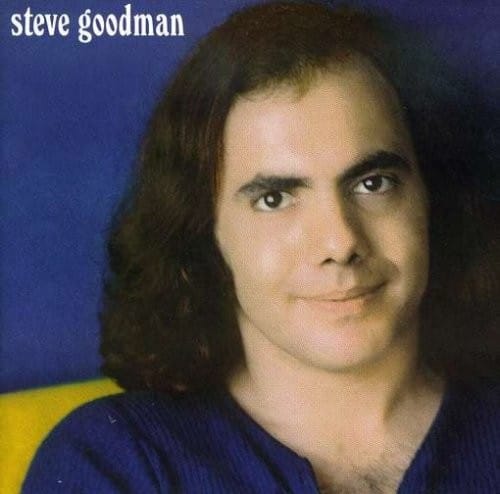
Steve Goodman's 1971 debut is a folk singer-songwriter classic that introduced "City of New Orleans" to the world. It's warm, unpretentious, and captures a young Chicago troubadour at his most direct. If you only know the Arlo Guthrie cover, you owe yourself the original.
Some debut albums sound like a statement of arrival. This one sounds like a Guy walking into your living room, sitting down on the edge of a worn couch, and saying, “You got a minute?” The guitar is already tuned. The room gets quiet. That’s the entire ethos of Steve Goodman’s first record, released in 1971 on Buddah Records.
Goodman was twenty-two when he cut these tracks. He had a bushy mustache, a gentle Chicago accent, and a way of writing songs that felt like letters you’d find in an old coat pocket. The album opens with “You’re the Girl I Love,” a plain-spoken declaration that doesn’t try to impress you. It just tells you the truth in a D chord. That’s the whole record in miniature.
The production came from Kris Kristofferson, who had heard Goodman playing in a Chicago club and brought him to New York to record. Kristofferson was already a star off the back of Kristofferson and The Silver Tongued Devil and I, but he kept the sessions loose. They worked at the legendary A&R Studios on 48th Street, a room that had seen Bob Dylan sing “Like a Rolling Stone” just six years earlier. The engineer was Don Hahn, who had cut The Band and Astral Weeks.
But the album doesn’t sound like any of those records. It sounds smaller, more intimate. Just Goodman’s Guild D-40, a handful of sidemen, and a lot of space. Jethro Burns, the mandolinist and half of the comedy duo Homer and Jethro, sat in on several cuts. His mandolin weaves through “Would You Like to Learn to Dance” like smoke through a screen door.
The centerpiece, of course, is “City of New Orleans.” Goodman wrote it on a napkin during an Amtrak ride from Chicago to Mattoon, Illinois. He was watching the Illinois farmland roll by and thinking about how the railroads that built the country were slowly dying. The song became a hit for Arlo Guthrie a year later, but it sounds different here. Slower. Sadder. The harmonica is a little out of tune, the vocal cracks on the high part. It’s the version nobody made for radio.
Two tracks were cut at the same session that didn’t make the original LP. One of them, “The Dutchman,” later became a standard for folk singers worldwide. But here on the 1971 debut, you hear it in embryo — just Goodman and his guitar, a gentle story about an old man fading into dementia, sung with zero sentimentality.
The rest of the album is relaxed to the point of seeming accidental. “Eight More Miles to Louisville” is a banjo tune with a laugh built into it. “Trouble in Mind” is a Richard M. Jones cover that Goodman slows to a shuffle. He never shouts. He never begs. He just tells you what he saw today and lets you decide how it makes you feel.
Goodman would go on to write more enduring songs — “A Dying Cub Fan’s Last Request,” “The Auctioneer” — but this first record has a kind of unpolished warmth that he never quite recaptured. It’s the sound of a songwriter before he knows anyone is listening. It’s the sound of a Guy on a couch with a guitar, and you got a minute? You’re going to take it.