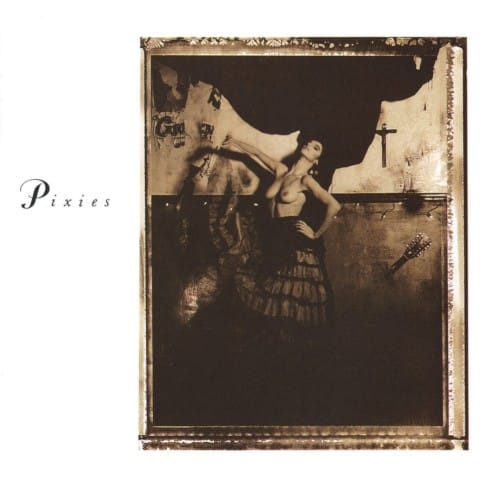
Surfer Rosa is the sound of a band that didn’t know they could be anything else. Raw, broken, disorienting, and impossibly beautiful. More than just the template for “Smells Like Teen Spirit” – it’s the album that taught loud-quiet-loud how to bleed. Essential for anyone who thinks punk had no future.
Some records you put on and the air leaves the room. Surfer Rosa doesn’t even let the air in — it’s a tape hiss and a snare hit and then a guitar that sounds like a car door slamming on the Chicago expressway. The Pixies’ first full-length album was recorded in four days at Q Division Studios in Boston, summer of 1987, on a budget that wouldn’t cover dinner for the band at the now-gone Chinese restaurant next door.
Steve Albini sat behind the board, and he did exactly what he would later do for Nirvana, the Jesus Lizard, and PJ Harvey: he made the room the instrument. He miced Dave Lovering’s drums with a pair of Neumanns and a single PZM taped to the tile floor, then pushed Black Francis’s vocals through a Shure SM57 into a compressor that had no business being that hot. The result is a sound that feels recorded in a garage with the doors open during a hurricane. You hear the air around the strings. You hear the room breathe.
The Sound of a Room
Albini once said that he doesn’t produce records, he just documents them. That philosophy is all over Surfer Rosa. The guitar on “Bone Machine” isn’t just abrasive — it sounds like Joey Santiago is trying to saw through the speaker cone with his pick. The bass on “Gigantic” is so thick and round that Kim Deal might as well be playing a cello, and her harmony with Francis on the chorus is the only moment of sweetness on the whole record. It’s the sound of a band that had been playing together for barely a year, and it’s perfect because of that.
The dynamics are the real star. “Where Is My Mind?” builds from a single clean guitar line into a wall of feedback that doesn’t resolve so much as surrender. “River Euphrates” pounds along like a Ramones song that swallowed a bad trip. And then there’s “Vamos,” a slow-burning noise experiment that sounds like it was recorded in a steel drum. It’s not a pretty record. It’s not even a comfortable record. But it’s alive in a way that few albums have ever managed.
The Quiet and the Loud
The loud-quiet-loud template that Kurt Cobain admitted to stealing would become the defining structure of ’90s alternative rock. But Surfer Rosa doesn’t use it as a gimmick. It uses it as a weapon. The whisper-to-scream shift in “Broken Face” feels less like a songwriting choice and more like a nervous breakdown on tape. The way Francis yelps “I am the king of the city” on “I’m Amazed” is less a declaration than a warning.
Albini mixed the album flat, which was a radical move in 1988 — no reverb, no panning, no fake stereo width. He said later that he wanted it to sound like the listener was standing in the room. So here’s the truth: Surfer Rosa is the best-sounding record Albini ever made, because it’s the only one that sounds like it might fall apart at any second. He never again let the tape run that hot, never again let the vocals clip that hard. He got it right the first time.
You put this record on at night, after the house is quiet, and it doesn’t feel like listening. It feels like someone just walked through the wall.