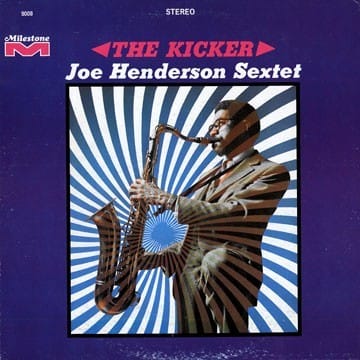
Joe Henderson's 1967 Milestone session is the sound of a tenor saxophonist at full maturity—blues-drenched, harmonically restless, and swinging with a rhythm section that knows exactly when to push and when to float.
The first time you hear the title track of The Kicker, you might think it’s a lost Blue Note session from 1964. The blues form, the loping swing, the way Henderson’s tenor climbs the changes like he’s remembering every solo he ever played and deciding to ignore them all. But this is 1967. The scene had shifted downtown, and Joe Henderson had left Blue Note for Orrin Keepnews’s new Milestone label.
He brought his working band into Plaza Sound Studios in New York. Kenny Barron on piano, Ron Carter on bass, Louis Hayes on drums. No one under sixty in the room, and everyone with something to prove. Hayes kicks “The Kicker” with a ride cymbal pattern that’s almost too relaxed—then Carter drops a walking line that locks the whole thing into a groove you can chew on.
The album was recorded over two days in April and May of 1967. Don Hahn was at the board, capturing a room sound that’s a little dryer than Rudy Van Gelder’s typical engineering, but with a front-to-back depth that makes you feel like you’re sitting three rows back at the Village Vanguard. The microphones caught Barron’s left hand with unusual clarity—listen for the way he comps behind Henderson’s solo on “Chelsea Bridge,” dropping whole-tone clusters that sound like rain on a tin roof.
That version of “Chelsea Bridge” is the album’s quiet fire. Henderson takes Billy Strayhorn’s melody and plays it almost completely unembellished for the first chorus, then starts pulling the harmony apart note by note. Barron follows him into the dissonance without hesitation. It’s the kind of telepathy that only comes from a rhythm section that has logged hundreds of miles together.
Side two opens with “Let’s Call This,” a Monk tune that Henderson had been carrying in his book for years. He doesn’t try to out-Monk it. Instead he plays the melody straight, then builds a solo out of fractured rhythmic phrases that sound like they’re falling upstairs. Hayes picks up the broken beat and turns it into a lopsided shuffle that somehow makes perfect sense.
The album’s oddest piece might be “The Out of Towner,” a Henderson original that starts with a stop-time head and then dissolves into a modal vamp. Carter plays a melodic bass line that doubles as the solo background. Barron stays mostly in the upper register, tinkling like a broken music box. Hayes keeps time with just his hi-hat and snare accents. It sounds like three musicians playing three different tunes that accidentally align every twelve bars.
Orrin Keepnews produced the session with a light hand. He let the quartet set up in a semicircle facing each other, with no isolation booths. The bleed between instruments gives the record a live, almost clublike feel. You can hear Henderson’s foot tapping on the floor during his quiet passages. You can hear Barron humming under his breath.
Joe Henderson would go on to make more famous records—Power to the People, Lush Life—but The Kicker is the one that captures him right at the hinge. Still playing hard bop with a modal vocabulary, still working with a rhythm section that knew his every tendency, still making records that sounded like a group of men in a room listening to each other with absolute attention.
Put it on after midnight. Volume just loud enough that the bass line walks through the room. Ron Carter’s note choices alone are worth the price of admission.