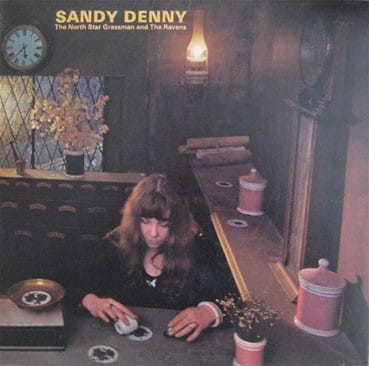
Sandy Denny's debut solo album, a pastoral ghost story set to folk-rock, where the voice that sang with Led Zeppelin and Fairport Convention turns inward. Fragile, strange, and absolutely essential for anyone who thinks they know 70s British folk.
You have to understand what she was leaving behind. Sandy Denny had already written “Who Knows Where the Time Goes” when she walked into Sound Techniques in Chelsea, 1971. She’d already sung on Liege & Lief. She was the only guest vocalist on a Led Zeppelin album.
The North Star Grassman and the Ravens is what happens when someone that gifted decides to stop being the voice of a band and start being the voice of a room.
The songs feel like they were written in that same late-afternoon light that hangs in the studio photos from the sessions. Open mics, just enough reverb, the wooden floor of Sound Techniques giving everything a low resonance. John Wood engineered and co-produced, and you can hear his hand in the air between the instruments — he never let them crowd her.
Dave Mattacks is on drums, pushing everything from a distance, never hitting too hard. Richard Thompson plays guitar with that peculiar tension he had in 1971 — half folk picker, half someone about to wreck the song. Dave Swarbrick’s fiddle sounds like it’s coming through a window from another field.
The opener, “Late November,” begins with a solo guitar figure so simple you could hum it in your sleep. Then her voice arrives, and the room changes temperature. It’s not pretty in the way singers are pretty. It’s precise and a little frayed at the edges, the vocal equivalent of a good tweed coat that’s been mended twice.
The title track is the strangest thing here. False notes. A lopsided waltz. It sounds like someone recorded it in a pub after closing time. I think that’s deliberate.
The Songs That Didn’t Stay Polite
The album has one genuine misstep — “Crazy Lady Blues” is too long and too cute by half. You can skip it. But the rest of it works because she refused to make the easy record. “Next Time Around” is grief set to a chord progression. “The Sea Captain” is a sea shanty that forgot to be cheerful.
What you’re really here for is the voice. It wraps around the corners of these songs like fog. The production is sometimes too gauzy — a little more high end would have served her — but that gauze became part of the album’s identity. It’s a record you have to lean into. It doesn’t come to you.
By 1973 she’d make the clearer, bigger Sandy. But this one? This one is the rough draft of a genius finding her own room, locking the door, and singing to the empty chairs.