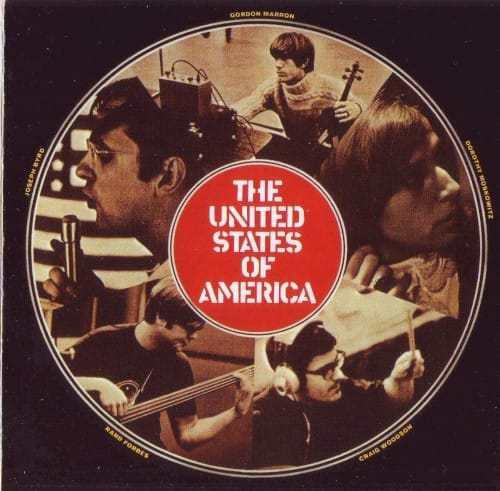
A 1968 psych-electronic landmark that predicted the future. Ring-modulated vocals, theremin, and acid-tinged songs about America. Obscure, unsettling, and essential for anyone who thinks electronic music started with Kraftwerk.
The United States of America is an album that sounds like a transmission from a future that never quite arrived. It opens with “The American Metaphysical Circus,” a title that could be a mission statement: organ swells, echo-laden drums, and Dorothy Moskowitz’s voice run through a ring modulator until it sounds like a shortwave broadcast from a collapsing star. This is not psychedelia as you know it. This is psychedelia built from soldered wires, scopes, and pure intent.
The band was the brainchild of Joe Byrd, a composer and multi-instrumentalist who had studied with John Cage and Morton Subotnick. He wanted to make pop music using electronic instruments not as novelty effects but as structural elements. So he built a system: ring modulators on the vocals and electric violin, a theremin played by Ed Bogas, and a primitive voltage-controlled oscillator used for bass lines. The result is an album that feels both ancient and impossible.
Recorded at TTG Studios in Hollywood in 1968, the sessions were tense. Byrd was a perfectionist with a mathematician’s ear, and the engineers—David Diller, primarily—had to figure out how to capture these untested sounds without the gear blowing up. The ring modulator, originally a telephone encryption device, was notoriously unstable; it could drift out of tune midsyllable, turning a word into a terrifying streak of noise. Moskowitz had to sing with military precision.
This is not a smooth listen. “Coming Down” is a slow dissolve of theremin and fuzz bass, Moskowitz’s voice floating somewhere between lament and landing signal. “Stranded in Time” uses tape echoes and a rhythm box to create a pulse that sounds like a machine’s heartbeat. The album’s centerpiece, “Cloud Song,” is the most conventional piece, but even its folk-tinged melody is undercut by an electronic hum that never lets you forget you’re inside a laboratory.
The band broke up almost immediately after the album was released. Byrd later said the chemistry was too unstable—both musically and personally. The album sold poorly. It was dismissed by some as pretentious noise. But over the decades, its influence has quietly spread. You can hear its DNA in Suicide, in early Human League, in the way Broadcast used the crackle of obsolete electronics to make something tender.
I would argue this is the first truly electronic rock album. Not “eight minutes of synthesizer noodling.” An album where the electronics are the songwriting—where the machines aren’t ornamenting the band, they are the band. The United States of America made one record that stands outside time. It still sounds like the future, just a more dangerous one than we got.