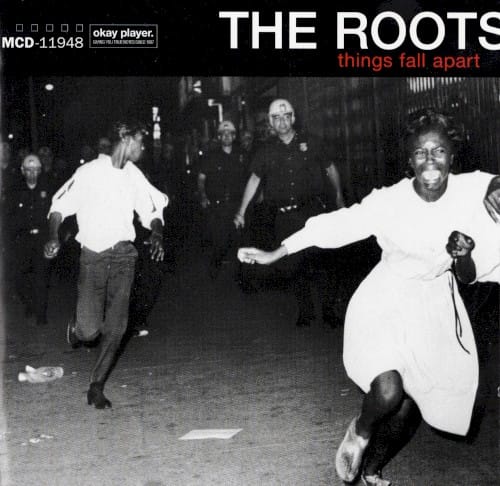
The Roots' fourth album is where hip-hop's best live band finally matched their studio ambition to their stage reputation. A dense, haunted, swinging record that owes as much to Public Enemy as to Pharaoh Sanders. Essential for anyone who thinks rap and musicianship don't mix.
You can hear the frost on the windows of Electric Lady Studios when Questlove’s kick drum opens “Act Too (The Love of My Life).” He’s playing a Yamaha Recording Custom kit that night, microphones placed by Bob Power about six inches off the shells. The room is dry, close, almost claustrophobic. It’s the sound of a band that had spent a thousand nights in vans and was done apologizing for taking the long way.
Things Fall Apart is the record where the Roots stopped being the token live rap group and started being the standard. Recorded across 1998 and 1999 at Electric Lady in New York and Studio A in Philadelphia, it’s the sound of eight musicians playing tight enough to sound like a machine and loose enough to breathe. Steve Mandel, the engineer who’d cut his teeth on jazz records, was the one who convinced them to leave the bleed between headphones and overheads. That ghost in the hi‑hat is intentional.
Black Thought sounds different here. On earlier records he was proving he could rhyme; on this one he’s writing eulogies. “Adrenaline!” is the closest he gets to a brag, and even that one feels like he’s looking over his shoulder. He’s flanked by Malik B., whose verses on “Step Into the Realm” are so tightly wound they sound like they might snap. Malik never got his due outside Philadelphia, and you can hear why that burns on every bar.
The guests are placed like chess pieces. Erykah Badu floats through “You Got Me” like she’s singing from the next room, which she was — her vocals were cut on a Neumann U 47 in the control room with the lights off. Common’s verse on “The Next Movement” was written in the hallway while DJ Jazzy Jeff looped the 16‑bar break from Roy Ayers’ “Coffy Is the Color.” Mos Def steps into “Know Thyself” and immediately makes the room feel smaller.
Bob Power mixed most of the record in two weeks straight, fueled by coffee and the nagging sense that this might be their last shot. The album’s title, borrowed from Chinua Achebe, isn’t decorative — it’s a thesis. The band was watching the music industry eat itself, watching friends get signed and dropped, watching the gap between what they could do and what radio would play grow wider. You can hear that pressure in the way the horn section hits on “Dynamite!” — not celebratory, just precise.
There’s a buried moment at the end of “The Spark” where a chair squeaks. The band left it in because it reminded them of the studio floor at 4 a.m., the hour when everything starts to sound true or terrible. That’s the whole album in one grace note.
No one had made a hip‑hop record that swung this hard since the Bomb Squad packed it in. And nobody has since, really. Listen to “Without a Doubt” — that’s a Fender Rhodes played by Kamal through a Leslie speaker that was probably older than he was, and it’s the only thing holding the song together while the rhythm section pulls apart. The balance is that delicate.
When the record hit stores in February 1999, it moved about 500,000 copies in six months. That wasn’t enough. But it was enough.