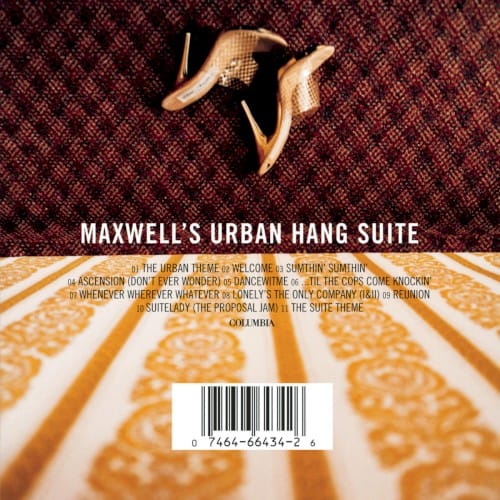
Maxwell's debut is the quiet storm that birthed neo-soul. Lush, bedroom-friendly, and sneakily sophisticated. For anyone who thinks '90s R&B was all jams and bass — this is the album that proved subtlety had power.
The first time you hear Urban Hang Suite, you have to check the year. The CD case says 1996, but the music feels like it drifted in from a 1974 after-hours session at Sigma Sound — all dampened cymbals, thick bass, and a voice that never rises above a conversational sigh. Maxwell didn’t invent neo-soul so much as rediscover a lost frequency, one that had been buried under sequenced drums and square-wave synths for nearly a decade.
He cut the album across three studios — Strongroom in London, Platinum Island in New York, and Battery in London — stitching together sessions with Stuart Matthewman, the guitarist and saxophonist from Sade who co-wrote and co-produced most of the record. Matthewman brought the dry, elegant pulse he’d perfected on Promise and Love Deluxe. Maxwell brought the vulnerability. The result is an R&B record that sounds like it was made in a single candlelit room between midnight and dawn, even though it took nearly two years.
The first two notes of “Ascension” — a single bass throb, then silence, then that voice — are still the most confident opening gambit in modern R&B. When the beat finally drops, it’s almost apologetic: kick drum, hi-hat, a finger-snapped ghost of a backbeat. Nothing forces itself. The song climbs in slow motion, adding strings, background vocals, a guitar that peeks around the corner and then disappears. It taught an entire generation that restraint could be a weapon.
What makes Urban Hang Suite endure is what it doesn’t do. No ad-libs. No vocal runs designed to prove capability. Maxwell sings most of the record in his lower register, close-miked, with a slight breathiness that feels intimate rather than engineered. On “Whenever Wherever Whatever,” he lets the melody fall into a near-whisper — the kind of delivery that requires absolute trust in the microphone and the listener. Thirty seconds of silence at the end of “The Suite Theme” isn’t a mistake; it’s a dare. He wants you to sit with the feeling.
The session players are mostly ghosts in the credits — no marquee names, just hands that understood the groove. Hod David, who would become Maxwell’s longtime collaborator, played guitar on several tracks. Matthewman handled sax and strings, keeping them low in the mix, more texture than statement. The bass is the real star: round, slightly overdriven, played with the kind of feel that makes you forget there’s a melody on top.
Twenty-five years later, that bassline still sounds like no one else’s. If you own a pair of headphones that rewards width and warmth, you’ll hear the tape hiss, the room gurgle, the ghost of everything that came before. Urban Hang Suite isn’t a time capsule. It’s a proof of concept — that quiet can be loud, that slow can be urgent, that an album can change a genre without raising its voice once.