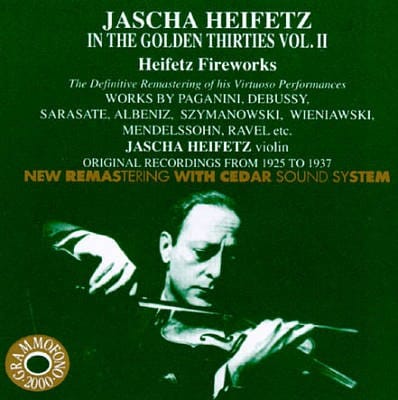
This three-concerto RCA collection captures Heifetz at his absolute apex — razor articulation, impossibly pure tone, and the kind of rhythmic drive that makes other violinists sound like they're playing underwater. If you want to hear what "violin god" actually sounded like before the word lost its meaning, start here.
You hear it in the first eight bars of the Brahms. Not the melody — the attack. Heifetz enters that D-major opening not like a soloist joining an orchestra but like a man walking into a room he already owns. The Chicago Symphony, under Fritz Reiner, follows him into that space. They don’t lead. They accommodate. That’s the power dynamic of these recordings.
The Tchaikovsky concerto was cut in Orchestra Hall, Chicago, in April 1957. Lewis Layton sat behind the RCA console. The Living Stereo was still new, and the engineers were learning how to capture a violin that didn’t want to be captured. Heifetz played a 1742 Guarneri del Gesù that had been his companion since the 1920s. It had a tone that the microphones struggled with — too much presence, too much something. Layton later said he had to pull the violin back in the mix to keep the orchestra audible. Listen to the first movement cadenza. Heifetz doesn’t so much play it as dismantle it, then reassemble it on the fly.
The Brahms had been in his repertoire for decades, but this 1955 Reiner collaboration is the one that stuck. The second movement oboe solo, played by Ray Still, is a masterclass in breath control. Heifetz waits. He doesn’t rush the entry. He knows the oboe needs its moment. Then he bows the theme with an evenness that makes you forget strings exist — you hear only the line, not the friction.
The Prokofiev Second Concerto, recorded in Boston’s Symphony Hall in 1959 with Charles Munch, is the wildcard. Heifetz was never a natural Prokofiev specialist — the angularity didn’t suit his innate lyricism. But he plays the first movement’s central melody with a straightness that makes it sound like something from another century. The cadenza in the third movement is where he lets go. It’s messy in the way only Heifetz could be messy — technically flawless but emotionally frayed.
These are not safe readings. Heifetz takes the Tchaikovsky first movement faster than anybody else in the LP era, and he doesn’t let up for the second subject. The orchestral tutti at rehearsal letter C is a blur. Some critics called it rushed. They weren’t wrong, but they missed the point. Heifetz didn’t play concertos — he prosecuted them. Speed was part of the argument.
The album, as compiled on RCA, has been reissued in various forms. The original Living Stereo pressings are worth chasing if you have a good turntable. The SACD remasters from the 2000s tamed some of the high-frequency glare without sanding off the knife edge. But the best way to hear this is still on vinyl, through a moving coil cartridge that can track the transient snap of those double stops.
Put the record on. The needle drops. First note of the Brahms — that G on the D string, held just long enough to make you lean in. Heifetz is about to walk through that door again, and he’s not waiting for you.