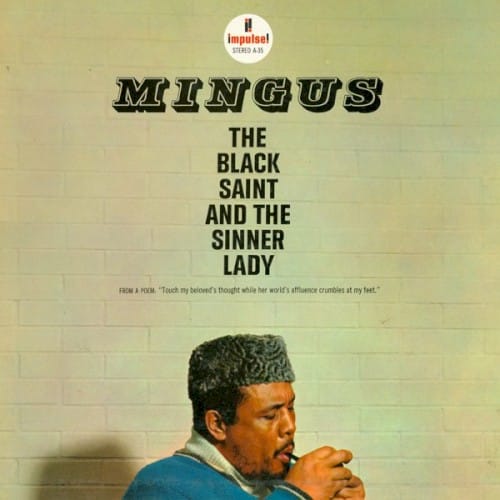
Charles Mingus's 1963 suite "The Black Saint and the Sinner Lady" remains a towering achievement in composed jazz—a six-part ballet score with no staged dance, its architecture built from blues, orchestral weight, and the friction between tenderness and violence. Rudy Van Gelder's engineering preserves the ensemble's spatial depth across two sides. Essential for anyone serious about large-scale jazz composition and Mingus's refusal of genre boundaries.

⚡ Quick Answer: "The Black Saint and the Sinner Lady" is Charles Mingus's 1963 masterpiece, originally conceived as a ballet with no staged choreography. Featuring eleven musicians including alto saxophonist Charlie Mariano, it's a six-part work exploring the tension between tenderness and convulsion across blues, jazz, and orchestral idioms. Recorded by engineer Rudy Van Gelder, its enormous dynamic range and spatial clarity demand quality playback equipment to fully experience Mingus's compositional vision.

Buy this recordVinyl·CD·Used & Rare

There are records that test your equipment, and then there are records that test your willingness to sit still and let something genuinely large happen to you.

The Black Saint and the Sinner Lady is the second kind. Mingus called it his greatest work, and he was not a man given to false modesty — which means something.

A Ballet With No Stage

He wrote it as a ballet, though no choreography was ever mounted in time for the recording. The dance lives entirely in the music: six parts across two sides of vinyl, a continuous argument between tenderness and convulsion, between the blues as grief and the blues as something close to joy.

The session was cut in January 1963 at Van Gelder Studio in Englewood Cliffs — Rudy Van Gelder’s room, where so much of what we now call jazz was captured on tape. Van Gelder had a gift for placing an ensemble in space without flattening it, and he needed every bit of it here.

Mingus brought eleven musicians into that room and pointed them at something that doesn’t have a clean genre name.

One album, every night.

Stream it on Amazon Music

Listen Now →

The People in the Room

Charlie Mariano played alto saxophone on this record, and that needs saying plainly: his tone is the emotional center of the whole thing. Mariano had a way of making the alto sound wounded without making it sound weak, and Mingus leaned on that quality throughout. Quentin Jackson on trombone provided the growl underneath, and Jaki Byard — who could play anything and usually did — took the piano chair.

The guitarist was Jay Berliner, a classical-trained player who brought a nylon-string delicacy that still surprises people the first time they hear it surface from the ensemble. Mingus himself played bass, of course, but not like furniture — like a second composer in the room, steering the whole thing from underneath.

Producer Bob Thiele let Mingus run the sessions. That was the right call. The music required someone who understood it completely, and only one person in that room did.

What the Record Actually Does

The opening track — “Track A — Solo Dancer” — doesn’t ease you in. The ensemble arrives at near-full weight inside the first thirty seconds, and the stereo spread is wide enough that on a good system you can hear individual instruments shifting position across the soundstage. This is one of those recordings where the room itself is part of what got captured.

The dynamic range is enormous. Passages of near-silence give way to ensemble passages that feel physical. If your speakers can’t move air, you will miss the bottom end of what Mingus built here, and that bottom end is load-bearing.

Mingus also commissioned his own therapist, Dr. Edmund Pollock, to write the original liner notes — a decision that was either deeply serious or deeply funny, and probably both. Pollock’s notes are a psychological portrait of Mingus through the music, written while the sessions were still warm. Nobody does that. Nobody did that. It tells you how seriously Mingus took this particular work.

There’s a moment late in “Track D — Trio and Group Dancers” where Mariano’s alto and the ensemble pull in opposite directions for about eight bars before arriving at something that sounds less like resolution than like exhausted agreement. I’ve heard that passage probably forty times and I still can’t fully account for it.

That’s what the great ones do.

The Record
Released1963
RecordedVan Gelder Studio, Englewood Cliffs, New Jersey, January 20, 1963
Produced byBob Thiele
Engineered byRudy Van Gelder
PersonnelCharles Mingus (bass), Charlie Mariano (alto saxophone), Quentin Jackson (trombone), Jay Berliner (guitar), Jaki Byard (piano), Don Ellis (trumpet), Richard Williams (trumpet), Dick Hafer (tenor saxophone, flute), Jerome Richardson (baritone saxophone, flute), Dannie Richmond (drums), Milt Hinton (bass)
Track listing
1. Track A — Solo Dancer (Stop! Look! And Listen, Sinner Jim Whitney!)2. Track B — Duet Solo Dancers (Hearts' Beat and Shades in Physical Embraces)3. Track C — Group Dancers (Soul Fusion) Freewoman and Oh, This Freedom's Slave Cries4. Track D — Trio and Group Dancers5. Track E — Single Solos and Group Dance (Saint and Sinner Join Hands in Merriment on the Occasion…)6. Track F — Group Dance, Coda (Holy Ghost — Souls of Your World in an Abandon of Joyful Mourning)

Where are they now
Charles Mingus — continued composing and leading groups through the 1970s, was diagnosed with ALS in 1977, and died in January 1979 at age 56.
Related Listening
Shares the spiritual intensity and modal jazz sophistication that defines Mingus's masterwork, with similarly searching emotional depth and orchestral arranging sensibility.
Features Mingus's contemporary peer Coltrane in dialogue with Ellington, capturing the same era's bold harmonic exploration and compositional ambition that Mingus embodied.
Dolphy was Mingus's collaborator and shares his compositional innovation, angular melodies, and willingness to blend avant-garde and soulful elements within the same recording.

More records worth your time.

Further Reading

🎵 Key Takeaways

What makes the recording quality of The Black Saint and the Sinner Lady important for listening?

Van Gelder captured the ensemble across a wide stereo field with dynamic range that requires proper speakers to reproduce—weak playback collapses the spatial positioning of individual instruments and loses the low-end frequencies Mingus deliberately composed into the bass lines. This is one of those records where room acoustics and equipment quality are inseparable from the composition itself.

Who is Charlie Mariano and why does he matter on this album?

Mariano was the alto saxophonist whose wounded-but-strong tone became the emotional center of the piece. Mingus specifically relied on Mariano's ability to sound fragile without sounding weak, and that quality shapes the entire character of the work across all six sections.

Why did Mingus have his therapist write the liner notes?

Dr. Edmund Pollock provided a psychological portrait of Mingus through the music while the sessions were still fresh, a decision that reflected how seriously Mingus regarded this particular recording. It's either deeply serious or deeply funny—probably both—but nobody else was doing liner notes like that in 1963.

What does the album structure look like across the two sides of vinyl?

The work is divided into six parts (tracks A through F) that function as movements in a suite—a continuous argument between tenderness and convulsion, orchestrated like a ballet that exists only in sound. It's designed to be experienced as a single statement rather than a collection of separate pieces.

Further Reading

Further Reading