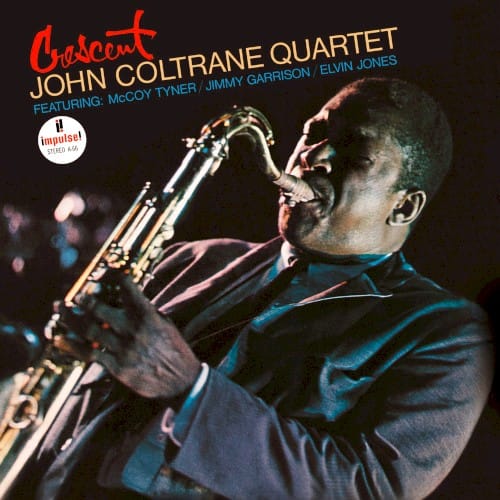
Crescent captures John Coltrane's Classic Quartet at its apex, suspended between the spiritual certitude of A Love Supreme and the free jazz rupture to follow. Recorded at Van Gelder Studio in June 1964, it showcases a band operating as a single organism—Elvin Jones's polyrhythmic independence, McCoy Tyner's spacious harmonies, Jimmy Garrison's anchoring bass—creating music that sounds startlingly modern. Essential for anyone serious about jazz.
⚡ Quick Answer: Crescent is John Coltrane's 1964 masterpiece capturing the Classic Quartet at peak telepathic unity. Recorded at Van Gelder Studio, it finds Coltrane suspended between A Love Supreme and free jazz, with Elvin Jones's polyrhythmic independence, McCoy Tyner's spacious harmonies, and pristine engineering creating music that remains startlingly modern and essential.
There is a kind of quiet that only opens up after midnight, and Crescent lives inside it.
Recorded over two sessions in June 1964 at Van Gelder Studio in Englewood Cliffs, New Jersey — the same room where Blue Note built half its catalog, where Rudy Van Gelder's microphone placement was as much an instrument as anything the musicians brought through the door — this album arrived in the strange corridor between A Love Supreme and the full free-jazz rupture that would follow. It is Coltrane in the last exhale before the leap.
The Band as a Single Organism
By 1964, the Classic Quartet had been playing together long enough that the music breathes differently than it does on any other record. McCoy Tyner at the piano, Jimmy Garrison on bass, Elvin Jones behind the kit — these weren't sidemen filling roles. They were load-bearing walls.
Elvin Jones is the reason this record still sounds modern. His polyrhythmic independence underneath Coltrane's long melodic statements creates a kind of controlled turbulence, like flying through weather in a plane you trust. He doesn't swing so much as revolve. Listen to what he does on the title track and try to locate the one. You can't. You stop trying and just float.
McCoy Tyner's voicings here are wide-interval and modal, rooted in quartal harmony, leaving enormous space in the middle register for Coltrane to move through. It's a lesson in accompaniment that pianists are still absorbing sixty years later. Garrison holds the bottom with a kind of patient authority — his arco work on "Lonnie's Lament" is understated and devastating.
Five Tracks, No Filler
The album runs five pieces, and every one of them earns its place. The title track opens with Coltrane's tenor finding a long, arching melody — not a head in the bebop sense, but something closer to a hymn that doesn't resolve. "Bessie's Blues" is the album's one moment of relative lightness, a shuffling 12-bar that still manages to feel earned rather than obligatory.
"Lonnie's Lament" is where I want people to start, honestly. It is slow and enormous. The melody moves the way weather moves. Coltrane's tone on tenor saxophone in this period — warm, slightly grainy, with an edge underneath like something held back — is one of the great sounds in recorded music, and Van Gelder captures it without flattering it into something prettier than it was.
"The Drum Thing" is essentially an Elvin Jones feature, and it's worth sitting with the liner notes open to understand what's happening rhythmically. On a good system, in a quiet room, the dimensionality of that performance is still startling.
Rudy Van Gelder gets overlooked in conversations about this record, but he shouldn't be. His room, his mics, his choices about where to put the piano relative to the drums — the imaging on this album, especially on vinyl or a lossless stream, is specific and alive. The musicians sound like they're in a room together, not assembled. That's harder than it sounds.
A Record That Doesn't Want to Comfort You
Crescent isn't the Coltrane record people reach for first, and that's exactly right. A Love Supreme is the cathedral. Crescent is the walk there, in November, alone.
It came out on Impulse! in 1964 — that orange-and-black label, those gatefold sleeves — and it was somewhat overshadowed by what came immediately before and after it. That's a shame it has spent sixty years quietly correcting.
Put it on after the house goes quiet. Don't multitask.
Further Reading
- Impulse Records in the 1960s: How the House of Fire Burned
- How to Listen to Jazz for Beginners (And Actually Hear It)
- Best Sounding Jazz Albums Ever Recorded: Where to Start
More from John Coltrane
🎵 Key Takeaways
- {'bullet': "⚡ Crescent captures the Classic Quartet at peak synchronization, recorded June 1964 at Van Gelder Studio with Elvin Jones's polyrhythmic independence and McCoy Tyner's spacious quartal voicings creating controlled turbulence beneath Coltrane's arching melodies."}
- {'bullet': "🎹 McCoy Tyner's wide-interval modal voicings and Elvin Jones's revolvingrhythmic approach—where the one disappears entirely—remain a masterclass in accompaniment sixty years later."}
- {'bullet': "🔊 Rudy Van Gelder's microphone placement and room engineering are inseparable from the album's sound; the musicians sit in actual space rather than being assembled, a technical achievement still rare today."}
- {'bullet': "📍 Five tracks, no filler—'Lonnie's Lament' is the recommended entry point, a slow meditation where Coltrane's warm, slightly grainy tenor with held-back edge reveals itself without flattery."}
- {'bullet': "🌙 Positioned between A Love Supreme's cathedral grandeur and the free-jazz rupture that followed, Crescent is the walk there alone in November—not the album people reach for first, which is exactly correct."}
What makes Elvin Jones's drumming on Crescent sound so modern?
Jones plays polyrhythmically independent underneath Coltrane's statements, creating rhythmic complexity where the downbeat becomes elusive—he revolves rather than swings, generating what the review calls 'controlled turbulence' that still sounds startlingly current. His refusal to anchor a traditional pulse while maintaining perfect ensemble communication was a radical approach to jazz timekeeping in 1964.
Why is Rudy Van Gelder's engineering considered crucial to this album's sound?
Van Gelder's microphone placement and room choices positioned musicians in three-dimensional space rather than as separate tracks assembled later, particularly evident in the imaging of piano against drums and the dimensionality of 'The Drum Thing.' His decisions about where to place instruments relative to each other are as much compositional choices as the music itself.
How does Crescent sit between A Love Supreme and Coltrane's later free jazz?
It occupies a strange middle ground—still structured around melody and harmony but with an unprecedented rhythmic independence and refusal to resolve cleanly, representing Coltrane suspended before the full harmonic dissolution that followed. It's post-conventional but not yet free, making it feel like a hinge moment in his discography.
Where should listeners start with Crescent?
'Lonnie's Lament' is the recommended entry—a slow piece where the melody moves like weather and Coltrane's tone reveals itself fully. The title track 'Crescent' is essential but rhythmically disorienting on first listen, so the ballad provides better entry into the album's emotional world.
Further Reading
- Impulse Records in the 1960s: How the House of Fire Burned
- How to Listen to Jazz for Beginners (And Actually Hear It)
- Best Sounding Jazz Albums Ever Recorded: Where to Start
More from John Coltrane
Further Reading
More from John Coltrane